I recently read two good books by Japanese-English author Kazuo Ishiguro. The first was “Remains of the Day,” (which I’ll abbreviate as RoD) first published in 1989. This is a first person narrative of an aging butler in England who looks back and reflects on his life and career. The second one is “An Artist of the Floating World,” (or AFW) published in 1986. This one is written in a similar style: an aging artist reflects back on the trajectory of his life in Japan, spanning both pre- and post-WWII. Both of my editions are the published by Faber & Faber.
I’d never heard of Ishiguro or either of these books when I saw them in a bookstore in Tokyo airport a few months ago. They looked interesting so I bought them and read them. So I guess you should occasionally judge books by their covers….you might stumble onto stuff you like.
Why am I lumping these together into a single post? They had enough in common that I think it makes sense to combine them, and due to these commonalities it is easy to compare them. And I would recommend both books for the same reason: they have relatively deep themes, which require the investment of some intellectual calories in order to penetrate below the surface of the narrative. In neither book is there an aha, lightbulb-on moment; it’s more like the lights get very slowly turned up with a dimmer switch. Both are great nominations for book club discussions.
Ishiguro’s storytelling style is unique, bolstered by the first person narrative that bounces from the present to the past. Additionally, in both books the point-of-narration progresses temporally through the story. In other words, while the narrator reflects on a series of events in his past, the point in time from which he is narrating progresses as well. So within each book you get sort of two parallel and interwoven stories: the past and the present. In RoD the “current” story takes place over six days, but the historical recollection takes place over roughly 30 years of the butler’s life. In AFW the narrator speaks from four distinct points in time over 20 months from 1948 to 1950, but the larger story that he relates spans from the early 1930s through WWII. In both books, as you finish the final pages, you look back at the story and there is a ton of unraveling to do. I’m still unraveling them even as I write this post.
I’ll review each book separately, then link them.
//
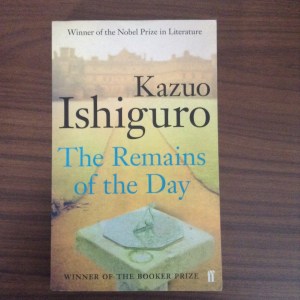
In RoD the protagonists Stevens takes a rare holiday through southwestern English countryside, during which he reflects back on his career as a butler. And over the course of the week as he travels, we gain an insight into his personal philosophies and see an evolution of his thoughts regarding the events of his life.
To start, I pulled out what I thought was a hidden gem of a quote, that captures what I think is sort of a sub-sub-sub theme of the book: that of the value of the get-away trip.
“…it is perhaps in the nature of coming away on a trip such as this that one is prompted towards such surprising new perspectives on topics one imagined one had long ago thought through thoroughly.” (p. 123)
As a sometimes-taker-of-trips, this resonated with me. The trip is often more than just a pleasurable vacation or escape; it can be a mechanism for personal growth. First, by physically leaving the environment and routines that we’re accustomed to and perhaps mired in, we are forced to open our mind to new possibilities. With that, we also are provided new perspectives on things we thought we had our minds already made up on. And above all, usually when you travel, you have time to think. And that’s what Stevens did – he thought – and we get to read his thoughts.
Throughout Stevens’ narrative, we experience him asserting his beliefs, wrestling with them, and towards the end perhaps slightly softening on some of them. Early in the story, he seems pretty staunch in his position of professionalism-uber-alles. He maintains a emotional distance from everyone, in keeping with what he calls the “dignity” of the profession of butler. This point is driven home when he attends to pressing professional matters even as his father is literally dying in bed in a room nearby.
He maintains this emotional distance as well with his co-workers. Most notably, there is an almost awkward tension between him and a female co-worker. Although he never states it explicitly, we are given hints that he has some level of feelings for her, personal if not romantic. Despite this, he adheres to his strict ethic of professionalism throughout, and even as she all but cries out to him for a personal connection, he maintains his rigid emotional exoskeleton. It’s worth noting, however, this this emotional coldness is not on Stevens’ part deliberate or malicious; it’s really all he knows. He was raised the son of a butler, and I felt that he literally just did not know how to connect with people on a personal level. Human connection was not a tool he had in his kit. We see this extend as well to the lord that he serves; he struggles with the ability to engage in casual conversation (“banter,” as he calls it), even though he knows he should.
Throughout his narration of the story, the reader witnesses cracks beginning to emerge in this exoskeleton, as well as a slight softening of his dogmatic view of some of the central tenets of his professional ethic. It is very subtle; since it is written as a first-person narrative by Stevens, he never outright states it explicitly. At points (usually at the end of chapters) he even seems to take on an argumentative defensive tone with the reader, as if clinging to the sinking ship of his old mindset. It’s almost as if he doesn’t want to admit or acknowledge new ideas that have crept into his mind…he argues against them vehemently even as the reader senses that they are taking hold.
He experiences a bit of a coming around at the very end of the story, as he watches a group of strangers interacting warmly on a dock.
“But as I listened to their exchanges, it became apparent they were strangers who had just happened upon one another here on this spot behind me. Evidently, they had all paused a moment for the lights coming on, and then proceeded to fall into conversation with one another. As I watch them now, they are laughing together merrily. It is curious how people can build such warmth among themselves so swiftly. It is possible these particulars persons are simply united by the anticipation of the night ahead.” (p. 257)
In this instance we can sense – again, it’s not explicitly stated – his realization and acknowledgement the importance of human connections. Here is the closest thing to an aha moment, where he recognizes that although his best days as a butler are behind him, there is much growth and personal experience to be had in his remaining years, in what “remains of the day.” He decides to put renewed effort towards “bantering,” which I interpret as a symbolic of personal, casual, and even intimate human connection.
I saw mirrors of my own issues in Stevens, issues that thankfully I think I am identifying earlier in my life. Emotional distance – the maintenance of some level of separation between your deep self and others – has limited many of my relationships, even those with close friends. In my early adult years I saw it as a strength – the ability to remain detached and in control of my emotions amidst turmoil and difficulty. Close human connections entailed vulnerability, and as a young man I was trying to become stronger, not more vulnerable. Although I still have much room to grow in this regard, I think I now better recognize – as Mr. Stephens does at the end of the book – that the essence and joy in being alive is in connection (and even vulnerability).
There’s much more to the book than I mention here; these are just some of the macro-themes that are at the front of my memory, over one month after finishing it.
//

In AFW the narrator Masuji is a retired artist in post WWII Japan, and his life reflections are brought on by circumstances he encounters while trying to arrange a marriage for his younger daughter. We come to learn, slowly over the course of the book, that after many years establishing his talents and reputation in the world of traditional Japanese art, he made the decision to walk away from it to put his talents to work in support of Japanese Imperial propaganda material during WWII. Prior to this shift, he had begun to feel disillusionment and a loss of purpose in the work he had been doing: painting domestic scenes in strict accordance with tradition. He left this all behind and went out on a limb to try to put his art to work in support of the national movement going on in Japan in the 1930’s and 1940’s.
However, after WWII the political climate in Japan changed dramatically, and in the new generation’s liberalization and modernization movement, Masuji’s past became a potential reputational liability and/or source of shame. The ramifications of this are significant in Japanese culture, where family reputation and standing is extremely important. Whereas he had been an esteemed artist prior to the war, respected and idolized by friends and pupils, in the political climate after the war he no longer holds the high status in the contemporary art world. Through the narration, he wrestles with this (perhaps percieved) fall from grace in the art community, and the loss of intimate community and status that he once enjoyed.
You know, my thoughts on this have changed even as I’ve been writing this post. I originally wrote that he had faced significant reputational damage due to his work in support of Imperial Japan, but the more I look back on it and ruminate about it… he really didn’t. He had a few isolated cases of broken friendships, but there were no indications that he was truly ostracized or shamed by society. Perhaps his fall from grace was due more to his retirement, the natural processes of moving into old age, and the devastation of his local community from bombings during the war. This makes me wonder how much the issues that he perceives are borne from his own demons and a sense of guilt, more than in response to actual societal blowback. His older daughter may have planted this guilt seed in his head, when she – perhaps mistakenly – insinuates that an earlier marriage arrangement failure was due to Masuji’s past. This insinuation may have brought some deep seated and repressed emotions to the surface, and kick started his introspection in which he comes to terms with his past decisions and actions.
Take for example, the events at his daughter’s miai. The miai is a sort of feeling-out event between the families of the potential bride and groom to be. During the miai for his younger daughter, Masuji felt it was duty to address his past. To him, it was the elephant in the room and needed to be brought out into the open. However – and I’ll let you decide for yourself – I think the elephant was more in Masuji’s head than out in the room. He came right out with it, and addressed his past with the group:
“There are some who would say it is people like myself who are responsible for the terrible things that happened to this nation of ours. As far as I am concerned, I freely admit I made many mistakes. I accept that much of what I did was ultimately harmful to our nation, that mine was part of an influence that resulted in untold suffering for our own people. I admit this. You see, Dr. Saito [the potential groom’s father], I admit this quite readily.” (p. 123)
As heartfelt as this statement was, it does more to confuse the group than address any real concerns. They are a bit taken aback, and after some awkwardness where the other family is not quite sure what he’s talking about, everyone just moves on to other subjects.
I think we all do this from time to time – we inflate in our own minds how much others dwell on our mistakes or shortfalls, or we are too quick to assume that others will hold grudges against us when we have slip-ups. Sometimes it’s probably appropriate and justified, but not always. It’s almost a form of egoism…. “I screwed up, and I know everyone is thinking about it, cause I’m what people think about.” Well…maybe…depending on the extent of the screw-up. But maybe others aren’t as enamored with your mistakes as you are; other people may be more forgiving of us than we can be of ourselves. Everyone ultimately has their own lives and their own set of issues to deal with. In the miai scenario in the book, I think we see a situation where the other family just wanted to move on, and was not interested in getting mired in Masuji’s past.
Nonetheless, whether negative feelings towards Masuji were real or perceived, his ruminations and philosophical introspection bring to light some profound themes. His overall perspective is that while it easy to judge his decisions with the luxury of hindsight, he maintains that he made them all out of genuine conviction of what he though was right at the time, and never because they were easy or convenient. Several times in his career he took major risks and went out on a limb to follow his beliefs, leaving behind circumstances of security in which he was a rising star in the art community. This, he says, is something he can be proud of, moreso than if he’d have remained safely neutral and just gone with the flow his entire life and career. Although he regrets some of the decisions he and others made, he says that “we at least acted on what we believed and did our utmost” (p. 204). We see this philosophy as he speaks about a recently deceased friend, on who had taken a similar path in life:
“He may indeed have looked back over his life and seen certain flaws, but surely he would have recognized also those aspects he could feel proud of. For, as he pointed out, the likes of him and me, we have the satisfaction of knowing that whatever we did, we did at the time in the best of faith. Of course, we took some bold steps and often did things with much single-mindedness; but this is surely preferable to never putting one’s convictions to the test, for lack of will or courage. When one holds convictions deeply enough, there surely comes a point when it is despicable to prevaricate further.” (p. 201-202)
Conversely, he pities those who choose the safe path:
“For their kind do not know what it is to risk everything in the endeavor to rise above the mediocre.” (p. 204)
There is one other point about Masuji that I’ll note; one that is very admirable. It would very easy for him to be bitter toward the new generation for their (perceived) attitude towards him: at worst a hostility, at best a lack of appreciation. However, he does not let himself fall into this trap. Despite his traditional upbringing, training, and background, he remains optimistic and open-minded to the new generation. This younger generation is more liberal, more modern, perhaps less tolerant of tradition, and maybe even with a rebellious streak in them (sound familiar?). There is every reason for Masuji to become an old embittered curmudgeon. Yet even has he reminisces nostalgically about the Japan he came of age in, he recognizes the necessity and inevitability of change, and looks towards the future with contentment and optimism. This is captured best in an extract from the final paragraph in the book (spoiler alert!):
“I smiled to myself as I watched these young office workers from my bench. Of course, at times, when I remember those brightly-lit bars and all those people gathered beneath the lamps, laughing a little more boisterously perhaps than those young men yesterday, but with much the same good-heartedness, I feel a certain nostalgia for the past and the district as it used to be. But to see how our city has been rebuilt, how things have recovered so rapidly over these years, fills me with genuine gladness.” (p. 206)
Similar to RoD, there is much more there than I capture here. I think this one is worth another read for me, now that I’ve thought about the book a bit. To go through it a second time might reveal more hidden themes. For example, Masuji gives some detailed accounts of some discussions with his young grandson Oji. I don’t really know what to make of them, or why Ishiguro devotes so much ink to what seem like trivial interactions. My guess is that Oji represents a the future generation at a more personal level to Masuji, since it is his own bloodline. But there’s probably more there that I missed.
Some comparisons
In Stevens and Masuji we see different perspectives on the meaning of dignity. Stevens’ dignity is a function of his adherence to a strict code of ethics. Masuji’s dignity is internal – he holds his head high due to his contentment with the decisions he has made. Masuji’s draws his sense of dignity from his intrinsic values and resultant actions/decisions, whereas Stevens’ dignity is in his adherence to a professional ethic.
This contrast is manifested throughout both stories in how the protagonists respond to challenging circumstances. As Steven’s starts to see troubling things going on within the household where he is employed, he ‘stays the course,’ so to speak. In adherence with his ethic, loyalty to his lord trumps any moral misgivings he may have about what that lord is doing.
Masuji, on the other hand, makes changes in his life when he sees that things are going in a direction he is not comfortable with. He does this at least twice in the book that I can recall off the top of my head. In doing so, he sort of abandons institutions an teachers that had invested significantly in him, and leaves his friends and coworkers – many of whom looked up to Masuji as a mentor. In this light, one could be critical of Masuji’s loyalty to himself over his institution. But it’s complex.
Which is more noble? It’s something to chew on. My first instinct is to say that loyalty to oneself is paramount, but it’s easy to shoot holes in that as a governing principle. Loyalty to oneself above all goes counter to the age-old and and widely recognized virtues of selflessness, sacrifice, compassion, empathy, and service. Conversely, it’s equally easy to shoot holes in the idea that loyalty to an extrinsic ethic or institution is a good governing principle. Selflessness has it’s time and place, and the butler embodies the extreme end of selflessness, probably to a fault. Like most things, there is a golden mean between loyalty to ones convictions, and loyalty to externals (like institutions or other people).
Did Masuji abandon his institutions, his teachers, and his comrades too quickly when opportunities and ambitions took the reigns? I think not, but one could probably convincingly argue yes. However, one could also make the case that his convictions were worth acting on – as Masuji himself argues.
I’ll also highlight one distinct similarity between the two, and it has to do with how the narrations end. As both narrations end, Stevens and Masuji look hopefully and optimistically towards the future, as we saw in Masuji’s quote above. This manifests similarly in both books; as each story closes the narrator is sitting somewhere and looking at members of the next generation, and looking hopefully towards the future. While Stevens and Masuji each have their own skeletons in the closet, and give hints of regret here and there, they ultimately accept their choices in life. Even as each is in the twilight of their careers, they look with contentment and optimism towards what the future may hold.
So what’s the lesson or takeaway here? I think Ishiguro is showing us the value and peace-of-mind that we can enjoy by reflecting on our past, being constructively critical of it, accepting it, and then looking to the future as an opportunity for positive change and growth. It is easy to do the opposite – remember the past with undue nostalgia and positivity, and be pessimistic about the present and future. While there is plenty to be concerned with in the world looking forward – there is also much to look forward to in the time we have to spend here. The conclusions of both RoD and AFW capture this sentiment.
*One subtle but noteworthy difference in the endings: Stevens is looking forward to what he will do with the rest of his life, whereas Masuji’s outlook is broader than that. He is looking with optimisim to the future of Japan, beyond his own time.
Recommendation:
Read both books.
If I had to pick one, I think I’d go with AFW, but only by a slim margin. It gets the edge probably because I still haven’t quite figured it out (not that I’ve figured out RoD, but I am slightly less perplexed by it). I may even read it again, because I’m sure there are some things I missed in the first go, and some of my initial ideas may either crystallize or change.
They’re both relatively short, but there’s a lot to them. What I like about them is that there is plenty of room for differing interpretations of the book’s themes – some of which I point out above. Absolutely challenge my interpretations above, or draw you own different conclusions. Keep a pencil handy as you read them, there are many passages that you’ll want to highlight or notate. If you do read one or both, I’d be interested to hear your thoughts.
 bradswebblog.com
Brad, I am looking forward to reading “An Artist in a Floating World”…..it’s our next bookclub selection and we have read ROD a few months back. Your comments are brilliant! I will post my comparison between the two after I finish reading this book. (even the title is intriguing!) I really enjoy your posts. M.
LikeLike