It’s been almost three months since I ran the Bear 100 miler. In the past I’ve generally written my race recaps soon after a race, when the physical and psychological residue from the race is still caked on pretty thick. Writing immediately after a race has its upsides. The memories are very fresh – the experience sits in the front of your short-term memory housing, and enables a more raw and intimate recollection.
This one might be different. An unintentional three months delay has allowed for this residue to slough off a bit, and perhaps given me a different perspective. There are downsides to this temporal distance too: you selectively remember certain things while others are forgotten or dulled. But I’ll do my best to hit the high-points and then the takeaways.
//
Race info at a glance
Distance: 100 miles
Start: Logan, Utah; 6:00 am Friday 28 Sept
Finish: Fish Haven, ID
Vertical gain: 22,000 ft
Starters: 317
Finishers: 221
Time Cutoff: 36 hrs
Result
Time: 26:19
Place: 41
I can say confidently that the Bear kicked my ass. Or, more accurately, I kicked my own ass. Probably moreso than any other race I’ve done. But that’s why we do this. No one signs up for a 100miler because its easy.
Macro level debrief is this: I thought I was running smartly in the first half, but signs of leg fatigue started showing up as early as 30 miles. Other than that I felt good, so I ignored the legs and kept up the pace, hoping that it was a false alarm and that it would go away or just stay where its at. Some really good miles between 40 and 50 re-affirmed that things were on track, or so I thought.
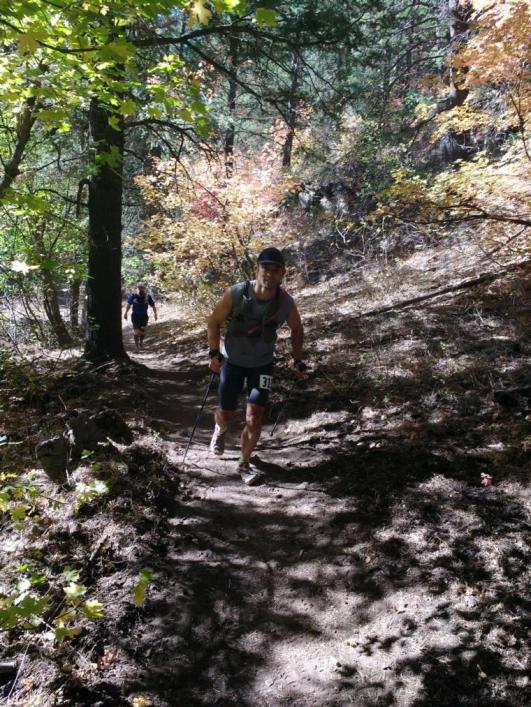
~mile 25
At the aid station at mile 51, I sat down to change socks and grab a few things from my drop bag. All good. I was there too long though; it took me a few more minutes than planned to re-organize my stuff.
When I got up to go, something was different. Legs were quite stiffened up, a significant change from just a few miles prior. I worked it out of the next few miles and was running ok by mile 55 or so, but the downward trend had begun. Over the next 20 miles the legs continued to go in the wrong direction. The 2 miles before the mile 76 aid station – Beaver Lodge – were a rocky and somewhat technical downhill, that I think put the finishing touches on my quads.
I got to Beaver Lodge at about midnight – 18 hrs in – and went inside. A few minutes later, Greg showed up. I had last seen him back around mile 30. We left the aid station together and decided to stick together, cause we were both struggling. Soon after, it became apparent that a 24 hour finish was no longer in the cards. After a few failed attempts at running, we fell into a power-hiking rhythm up a long gradual climb…a gear we would stay in for the rest of the race. We essentially power-hiked miles 76-99…pushing the hike pace to stay warm, but taking nice deliberate aid station stops to take in calories. These miles were tough and slow.
If there was a silver lining to this, its that we crested the ridge before the final 5 mile descent right as it was starting to get light. The sun broke the horizon as we descended off the mountain into the town of Fish Haven and the finish line. That final descent was pretty brutal – loose rutted out rocky trail – but the finish line was near and we had the benefit of sunlight. We found a little bit of reserves in our legs, and ran the last mile into the finish. 26:19 total time.
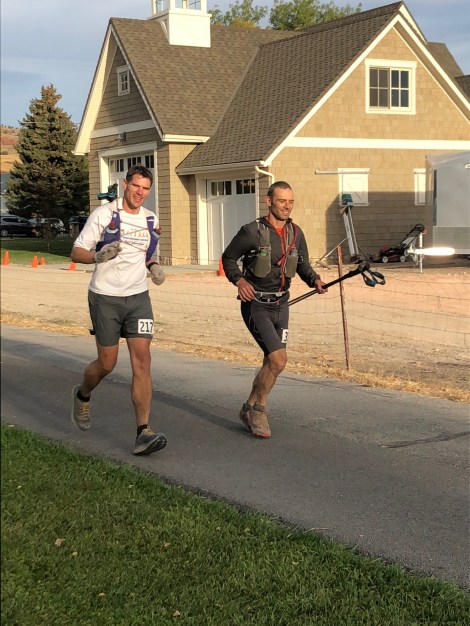
Coming into the finish with Greg
My sister Roberta and her friend Tonto were there to see us finish and provided us with ground pads to lie on and catch some sleep over the next couple hours, before we hitched a ride back to Logan.
//
A couple takeaways:
1) Pace and strategy: In all three of my races this year, I ran well through 50 miles. At Lake Sonoma, the race ended at 50 miles, so that worked out nicely. At Castle Peak I hit a bit of a wall at 50 miles and had some rough miles between there and the finish. At the Bear, the same thing happened, but in this case I still had 50 miles to go….that’s a long way to push through. In both instances it was more of a muscular decline than a systemic one. I felt ok in mind and body, but my legs basically started to call it a day.
I take two things away from this. First, even though I wasn’t blazing fast in the first half, I perhaps drained the tank a little faster than I should have. I talked to my coach Corrine beforehand, and she advised me not to worry about splits at all during the first half of the race. But I couldn’t help myself. I started thinking about splits and time early on, as early as 20 miles, and started honing in on the 24 hour mark early. I thought that if I could get to the mile 51 aid station by 11 hours, I had a good shot at breaking 24, and even let my brain start to toss around the idea of 23 hrs. Turns out I got there in just under 11 hrs, but proably at the expense of the ultimate 24 hr goal. As mentioned, I had warning signs as early as 30 miles that maybe I should back off and regroup, but I ignored them in order to hit this intermediate 51-mile time goal. Hopefully I’ve learned a lesson (we’ll see!), and in my next race I’ll ignore the clock and splits for longer, and maybe heed Corrine’s advice a little better.
Also, I think that in the future, to do better at these longer distances, I’ll have to do more weekly mileage, and/or integrate more running intensity. My training regimen through the summer was limited by the injured hip, so I averaged 45-55 miles a week running….not enough for 100-miler prep. I did do intensity work, but it was on the bike. I’m sure these helped with fitness, but the leg strength gains weren’t running specific. However, all things considered, we made the most out of the situation I was in. I really like the unique and profound challenges of the 100 mile distance, so hopefully I’ll be able to return to a training program that allows me a more comprehensive preparation.
Also – there’s no denying the impact of altitude. Much like Castle Peak, the majority of this race took place between 7000 and 9000 feet. Even though I don’t remember feeling acute effects, the thin air is a factor. It tempers your exertion, but I’m not sure how it effects muscular fatigue.
2) 100 miles is far, 26 hours is short: This one shouldn’t need a mention, but it was hammered home. It’s possible to forget how far it actually is. During the race it’s probably helpful to forget how far you still have to go… early on the remaining mileage can be intimidating. We train for these and break the race into sections and try to be as objective and scientific about the process as we can. Also, 100 milers are common now – there is one almost every weekend now in the U.S. alone, and the results are easily accessible. But as they become more common, they don’t get any shorter or easier. The bottom line is:
100 miles is a f#*%ing long way to travel on foot in one day. There’s no getting around that fact.
At the same time, a day is not long. 24 hours is not long. 30 hours is not long. In the longer journey, these are extremely trivial time periods. Yet in these races we manage to pack a disproportionate amount of experience into a very short time window. It seems long while you’re in it. Now that I’m three months out, I look back at the race and the “shortness” of this time window is more apparent.
It’s just a f#*%ing day. There’s no getting around that fact, either.
3) Process vs results: So I didn’t get the result I wanted. As my second 100 miler, I had hoped to better my time from my first. But….the race is not all about finishing times. Yes, I’m aware that I’m conveniently rationalizing. Nonetheless, in ultra running I think this is especially true. A finish in a 100 miler is a growth experience, no matter how long it takes you to get there In fact, I am becoming more attuned to the fact that a result – while providing us something with a good focal point and goal – is a very poor metric for capturing the race experience. All it shows is the time elapsed from the start line to the finish line, and doesn’t tell you much about what happened in between.
My 2018 running year culminated here, over the 26+ hours in the mountains NE of Logan, UT. I learned a lot about racing, running, and about myself. I think I come away from the Bear with a better perspective on running. And I have now a good excuse to come back and do this race again. It won’t be in 2019…too much uncertainty right now with my hip and with my next job schedule (plus the race is already full), but one of these coming years I will come back and give it another go.
 bradswebblog.com
Great report Brad – Glad you went back and wrote this to get it on the record.
LikeLike