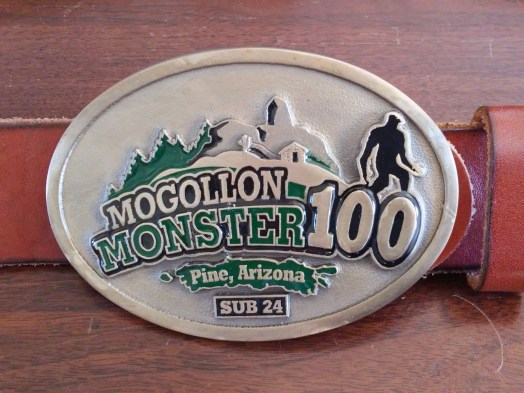
I crossed the quiet finish line at 5:40am, just before sunrise on Sunday morning, 17 September. 23:40 total time, fourth place, and a sub-24 hour buckle. It was a great race; I executed my gameplan (see pre-race post ), and it paid off. Here is a recap of my experience from the Mogollon Monster 100 mile run….
I’d never heard of Mogollon Monster until last December. I’d just finished Hellgate, and was treating my post-race hangover by lining up races for the following year. Even though Hellgate had crushed me, I felt I was ready to step up to the 100 mile distance in 2017. I’d already signed up for Castle Peak 100k (26 Aug), recommended by Greg, and so I was looking for something in the late Sept/early Oct time window.
I came across Mogollon Monster when I was perusing the list of Hardrock qualifiers. It fell only three weeks after Castle Peak, which I felt was a little close, but doable. I clicked “Register” on ultrasignup.com
Through luck, the timing actually ended up working out perfectly. I didn’t know it last December, but 16 Sept fell smack dab in the middle of my between-quarter break at the grad school I’m attending in Monterey. A week earlier or later and it would have been tough to make this work with my school schedule. And as it turns out, three weeks recovery from Castle Peak was about right.
I went into Castle Peak in late August coming off probably my best 10 week training block yet. In hindsight, this may have bred a bit of overconfidence. Castle Peak is a legit hard course, and it checked me back to reality. I did well, but got worked by altitude, dehydration, and heat, and was beaten down by about 41 miles in. It wasn’t till a healthy aid station stop at mile 50 that I was able to rebound and run well again. I ended up finishing 14th overall in 14:43.
The three weeks after Castle Peak and before Mogollon were light on the running, heavy on recovery. I totaled about 60 training miles across those three weeks. Recovery from Castle Peak was relatively quick, but I went easy to make sure that I was both physically and mentally rested and ready for Mogollon. Plus my academic quarter was coming to a close, so I was pretty busy with schoolwork during this period.
//
Cut to the race weekend. Pine, AZ is a cool little town in the mountains about 90 minutes NE of Phoenix. The evening prior to the race, we all went out to eat at the town’s pizza and beer joint. Packet/bib pickup, a woodfired pizza, a restless Finley, and a couple good microbrews, and we headed back to the cabin to get to bed early for a 430am wakeup.
Drove to the start line with Dad and Greg. It was still dark but getting light, and a little chilly. After a few short pre-race announcements from Aravaipa Running, the race organizers, we kicked off at 0600.
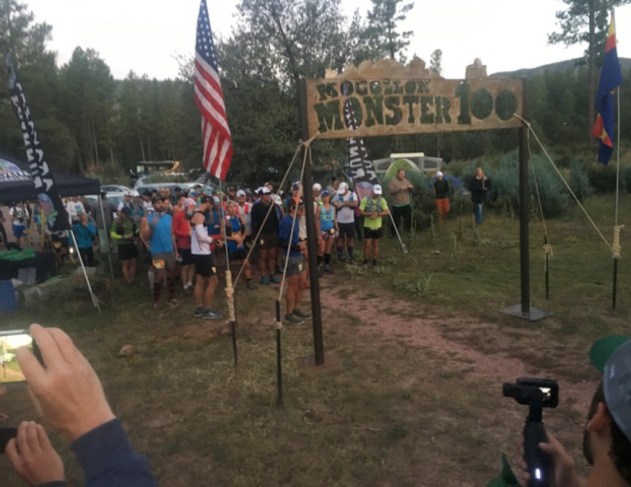
The start line
Kept it very relaxed and mellow for the first 20 miles. Ran the easy sections easy, and fast-hiked the uphills. I ran slick (no vest or water bottles) for the first 10 miles, which made for easy running. The first crewed aid station was early, at mile 10 where I grabbed my vest and water, and said bye to Dad (he had to take off to catch his flight back to SD).
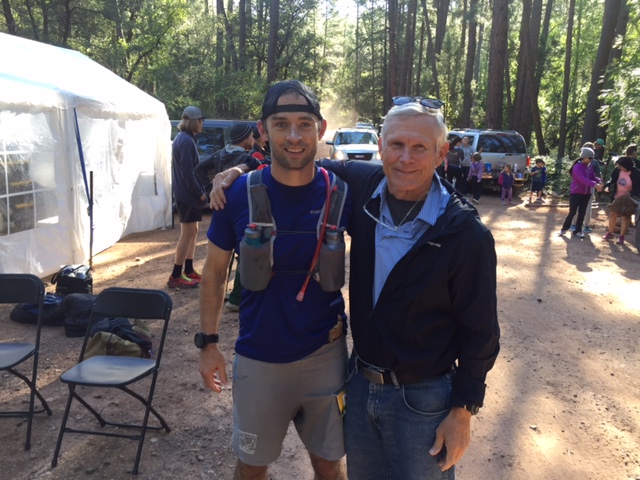
Geronimo Aid station – mile 10. With Dad
After another awesome 10 miles heading east along the highline trail below the Mogollon rim, I saw the crew (now Greg, my wife Allie, and my daughter Finley) again at mile 20, Washington Park. Greg informed me that he’d probably be joining me at mile 43 instead of 56, due to logistical challenges making it to the mile 56 aid station. So he’d be running 57 miles of the race with me.
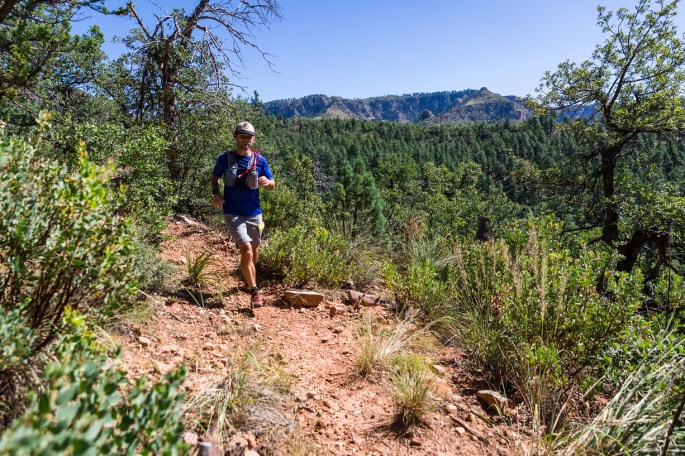
Good trails, ~ mile 15. photo by Sweet M images
After Washington park we slogged up a short but very steep climb to the Mogollon Rim. The next 23 mile segment consisted of singletrack through the Ponderosa pine forests at about 7000 ft above the Mogollon rim. After a brief stint feeling the effects of altitude, I started feeling strong again. I was conscious that there were still a lot of miles left, but just ran at a pace that felt natural and relaxed. The terrain through here was amazing…..rolling singletrack through pine forest and meadows, fully forested, and long stretches of wilderness. After a beautiful 5+ hour loop in the daylight, I dropped back down off the rim (down the same steep climb I’d climbed earlier) to Washington Park Aid station, for the last crewed access of the race. I blistered my toes pretty good during this descent.
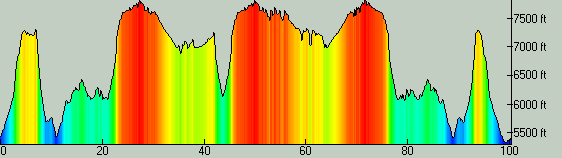
Mogollon Monster 100 course profile. You can see that most of miles 22-78 are above the Mogollon Rim, only dropping down at mile 43 for an aid station. Note the gnarly climb at mile 92…that was a good one. Image copied from Mogollon Monster website: http://www.mogollonmonster100.com
I arrived Washington Park (mile 43), and Allie went to work lancing and draining the couple big blood blisters on my toes. I threw on some fresh socks, put down some good food, and made sure I had everything I’d need for the night, since we didn’t expect to be back to this spot until mile 78. Since I was still moving well and able to maintain a decent work output, I only grabbed my Patagonia Houdini windbreaker and a head buff. I’d been hearing that it got really cold up on the rim at night, but we did some quick calcs and predicted that we could be back to Washington Park by midnight, hopefully ahead of the really low temps.
Greg and I left Washington Park at about 3:50 pm. Had to hike the steep 2 miles back up to the rim. After this was about 4 miles of very run-able fire road, then we turned off onto single track and hit Houston Brothers Aid station, at roughly mile 50, the halfway point.
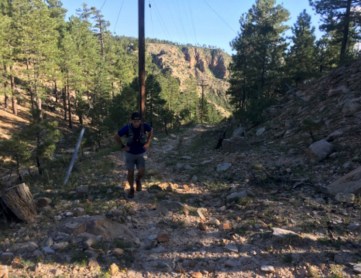
The slog back up to the rim. ~mile 45
This second above-the-rim loop was different from the first, but shared a few of the previous aid stations. Given the mileage under our belts, we were able to run relatively strong through this loop. Aid station stops were not rushed, but deliberate and we didn’t dawdle. Greg was good about making sure I ate some food at every aid stop, which I’m not usually good at. At mile 65 I had my first cup of coffee, in order to fend off any pending sleepiness. That coffee (along with a half a grilled cheese sandwich) was a shot of energy to the system. We were setting goal splits for each segment as we went along, and were roughly hitting them. Greg and I would break into conversation every once and a while when the running was easy, but for the most part we were focused on keeping the pace. At our last aid station on this loop, mile 72, we passed another runner and moved into 4th place overall. We ran hard back down the fireroad, dropped down off the rim on the steep, loose, rocky descent, and came back into Washington Park a few minutes before midnight.
At this point we knew that sub-24 was within reach. Six hours to go 22 miles. By normal running standards this is almost a gimme. But given the terrain we had to move through, we’d have to stay game the whole time. Coming up next was a ten mile segment along the highline trail, which didn’t contain any big climbs, but was technical and up-and-down throughout. And parts of it were overgrown, so route finding at night would prove to be an additional challenge.
This ten mile segment ended up taking us over 2 hours and 45 minutes, even though we pushed it the whole way. It seemed to go on forever. Ten miles is a long aid station stretch anytime, but it definitely seemed longer at 2 am than it did the previous morning on fresh legs in the daylight, going the other direction. We couldn’t really run for more than a minute at a stretch before hitting some short steep climb or technical hike terrain.
Leaving Geronimo aid station at mile 88, we had just over 3 hours to travel 12 miles, which included a very steep 1500 foot climb, and a technical overgrown descent into Pine. I was honestly not optimistic about our chances, especially given that it had taken us almost that long to go the previous ten miles, without any major climbs.
For the first time all race, Greg got in front of me to set the pace. He aggressively ran the 4 miles of run-able but uphill trail leading up to the crux climb. I remember this as being the hardest I ran all race. I’m sure our pace wasn’t impressive by objective standards, but we were working hard. Then we hit the steep climb. We traded off leads, and hiked as hard as we could up a very steep and relatively technical 1-2 mile segment up to the top of the rim. It was a hands-on-knees, high heartrate, borderline threshhold effort. I never looked at my watch during this section, but I knew if we could make it into the next aid station at mile 94 by about 4:40am, sub-24 was still in the realm of possible. We crested the top of the rim, came into the last aid station, and I looked at my watch…4:10. Unbelievable…we’d hit 75 minutes for that 6 mile section that included a gnarly climb. In hindsight, that section made the race.
From there, we cruised down descent off the SW side of the rim, past the starting line and 1.5 miles back into the town of Pine. Light was just starting to show up on the horizon. Just off the main street in town was the community center and the finish line.
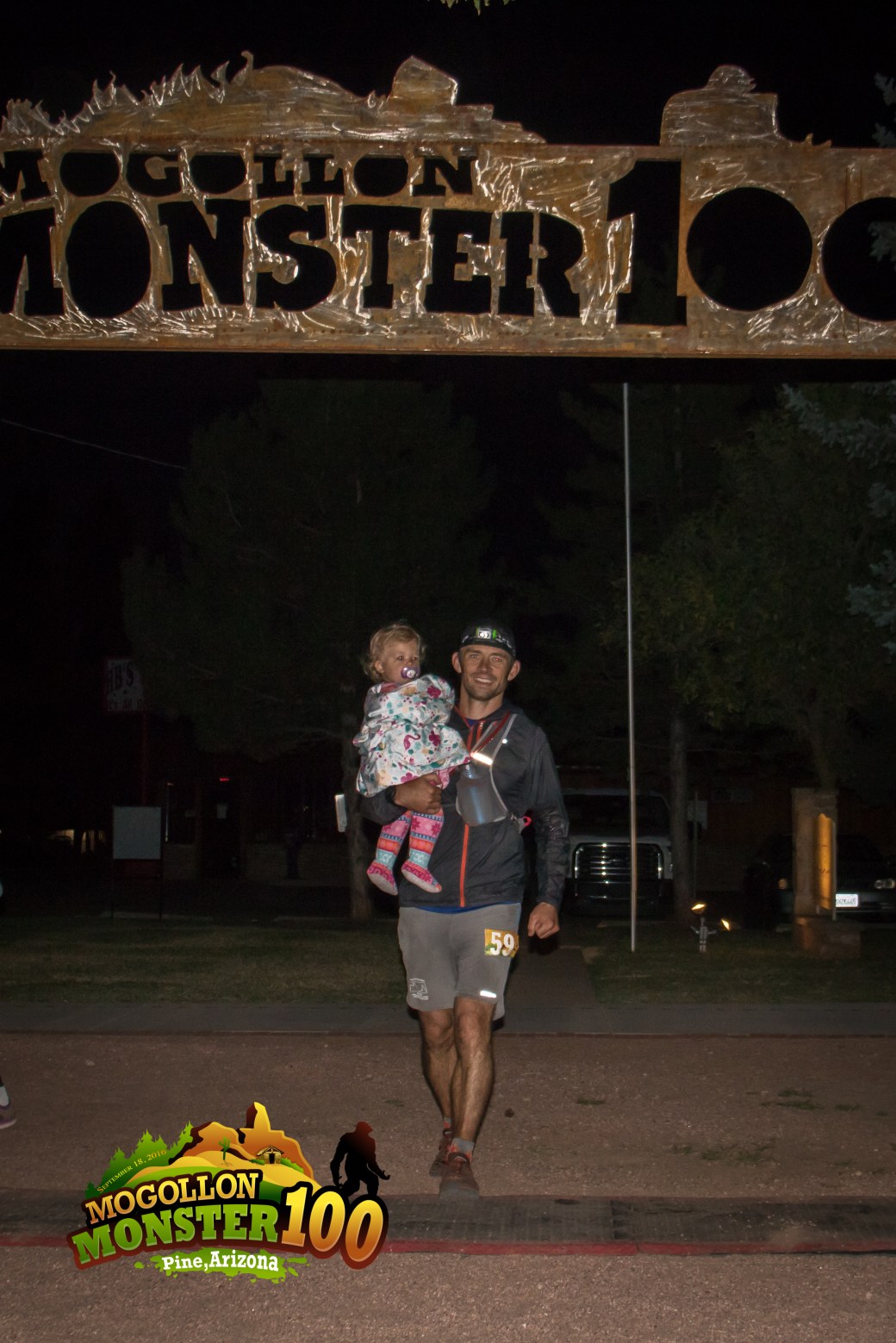
The finish line. Photo by Aravaipa Running
I carried Finley across the finish line at 5:40 am, got my buckle, and sat down. It felt good to be done, but even better to get the sub-24 buckle. We’d been absolutely focused on it since somewhere around mile 50. Greg and I had a celebratory post-race beer at 6am, and then we started to get cold, so we loaded up in the van and headed back to our cabin for showers and naps. We came back in the afternoon watch some more finishers come across the line, drink beer, and eat ice cream.
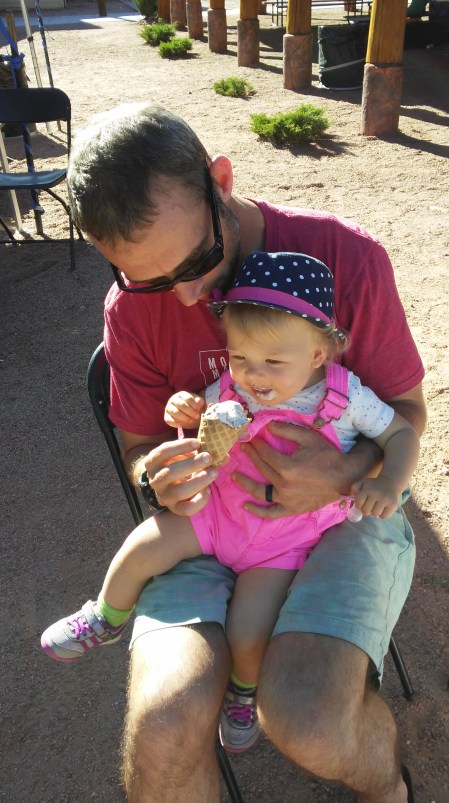
Afternoon ice cream at the finish line with Fin
Takeaways:
-Food: Until this race, I’ve generally eschewed taking in a lot of calories during runs or races. I would still say that up to 50 miles, you can probably perform well on very little calorie intake. But as my buddy Carter had been telling me for some time, “Dude, you gotta eat during 100 milers.” And after a PB&J pulled me out of a deep funk at Castle Peak, I immediately recognized the value of food in races over 12 hours long. So at Mogollon Monster, I ate. And it was good.
I told myself before the race that I’d eat at every aid station from mile 20 on. Well I got a jumpstart on that with an almond butter/banana/chocolate chip wrap at mile 10. From there on, I made sure to eat a little bit of real food at every aid station…..usually some PB&J or a quesadilla along with fruit and some pretzels. By eating frequently, I was able to eat pretty small portions, which for the most part kept me feeling light.
As Greg and I went into the night, I added coffee to the aid station regimen. Coffee gave a noticeable boost, but I was careful to use it in moderation, knowing it could speed up the GI tract if taken too liberally. I had three cups of coffee through the night. I like coffee, and it’s just as good during a run as it is on a lazy weekend morning at home.
I’m fortunate that I have a relatively resilient stomach when it comes to food/calories and running. I know a lot of runners deal with stomach issues and nausea as a matter of course on long ultras, or they have a very narrow range of foods, gels, or electrolytes that they can stomach. So far, I haven’t had any issues or sensitivities, so I’m able to pretty much eat whatever’s available at aid stations. I do try to steer more towards real foods and less towards candy, gels, or bars.
-Water: I wore a new Ultraspire vest (Velocity model) for this race, due to its higher water capacity and the long stretches between aid stations. My old vest (Ultraspire Spry) carries 40oz of water, and I’d often run dry during hot sections of races a few miles after filling up. This definitely happened to me at Castle peak. The new vest has a bladder in back that carries an additional 70oz of water, for 110oz total (math!). As a result, I was never wanting for water during the race. I drank often, and I think I stayed relatively hydrated throughout, and even peed a few times late in the race. And as an added bonus, when the bladder was full of ice water, it had a cooling effect along the spinal column.
-Pacer: I have paced before (in June at Western States), but this was the first time I’d ever had a pacer during a race. It is definitely helpful. Greg has way more experience than me, and I’ve been running with him since I got into running almost two years ago, so he was the perfect guy to run with for the second half of the race. Plus he did Hardrock two months prior, so I got to hear some good Hardrock stories as we ran. 57 miles overnight is no walk in the park, and he ran really well (in brand new shoes, by the way…). As mentioned above, he took lead when we really needed a boost, and crushed a crucial section.
In addition to this, running with a pacer can harness some “group flow” energy that’s not available when running solo. Even with a group size of two, the effects of group flow are real and palpable, especially when running singletrack or doubletrack in the middle of the woods at night.
Greg has a theory – and I think he’s probably on point – that in order to get a full, true 100 mile experience you should do one solo, without a pacer. He’s not anti-pacer, but his perspective is that running solo forces you to confront psychological challenges head-on, with no one to distract you from them. A good point, at some point down the line I’ll definitely do this.
However, a good pacer makes it more enjoyable, adds an element of safety, and although they are not allowed to physically assist (they can’t carry your gear, push you up hills, etc), the mental boost of just having someone with you is significant.
-Energy management: I went out very conservative, almost painfully so, in the first 20 miles of the race, but I think it worked out for the better. Knowing I had 80 miles to make up time helped temper the desire to hit the throttle early. I also fell in with small groups of other runners for several miles at a time and this helped me maintain an even, mellow pace.
Another piece of advice I took from Greg: try to get to the 50mile mark feeling like you’re ready to start running. Well, this is actually impossible, unless you walk the entire first 50 miles, but taking this approach does put you in the right pace/effort mindset early in the race. For me, it meant slowing down or walking if/when I felt my heartrate getting jacked, or breathing becoming too heavy. In short….try to take it easy.
As it was, I came into mile 43 and felt pretty good, ready to pick up Greg and get back out there. This was a good place to be, and I think it manifested itself with a good second loop above the rim. We hit the 50 mile mark somewhere around 11 1/2 hours.
-24 hour mark: The 24 hour finish goal drove our race for the last 40 miles or so. We were calculating and recalculating splits, estimates, and aid station stop times on the go, in order to try to get back to Pine by 6am. It provided us with a sense of urgency, and added an element of excitement to those last 6-8 hours. Had we been about an hour or so behind where we were at mile 72, twenty four hours would have been out of reach and we would have had to find some other motivation to help push those last 28 miles. Before the race I had said 28 hours was my goal, but there were a lot of unknowns, I was tentative to overshoot, and I was erring on the conservative side. At mile 43 we re-assessed and set 24 hours as the new mark, and this shaped the rest of our race.
I guess a good lesson for me is that pre-race goals are definitely good, but it is also good to re-assess periodically to maintain a goal that is just barely within reach. Too lax, and it removes the motivation to press the effort. Too aggressive, and it either quickly becomes out of reach, or causes you to push an unsustainable pace and blow up. If that goal becomes just crossing the finish line, that’s ok, as long as it drives you to keep going.
-First 100 miler: Maybe it’s because I had a good race, but I do like the 100 mile distance. It seems there’s more time for strategy to play out than in a 50miler or 100k. The extra 10-12 hours provide much more time for things to either go well or go wrong. And there’s definitely a different mindset early in the race, as you know that you’ll be out there not just all day, but through the coming night as well. That fact alone calibrates your headspace and energy management. But it still retains the feeling of a race, that competitive atmosphere that can be more intense in shorter events. Everyone is still trying to get the finish line as fast as they can.
So yes….I’ll be doing more of them.
What’s next for me?…. I’m doing a 50k up near SanFran in Nov (Mt. Tam Trail Run 50k), and then I’ll see how the lotteries go in December before I line up any 2018 races. I’d really like to do Castle Peak again next year, both because I want to do better and because the course is absolutely amazing. I’ll put in the Hardrock and Western States lotteries, but I think my chances to make either are in the low single digit percentage. But I gotta start sometime, and I’ll hopefully get selected for one or both sometime in the next 5 years. There are still tons of good races out there to run.
A few shout outs / thank you’s:
- Aravaipa Running for putting on this great event. The trail delivered….it was difficult and beautiful.
- All the volunteers who made the race possible. Great aid stations throughout!
- Greg for taking a weekend away from family to come out and run with me.
- My loving wife Allison and daughter Finley. They spent all day at one of the hottest locations on the course, and were all smiles when I came through. They are nothing but supportive, and it means a lot to me to see them during and after the race. Finley is only 16 months old, but she’s already crewed seven ultras….she’s becoming quite the seasoned ultramarathon crewer!
- My grandfather Opa. He lives in Prescott and is nearing the end of his time, but is staying upbeat and is an inspiration to everyone that has known him. Thanks Opa!
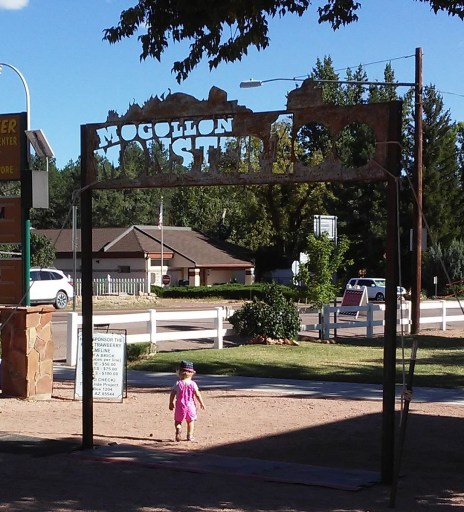
Mogollon Monster sighting….


Papa and I are so proud of you and your support crew. Great to see Miss Finley out at 5:40 am cheering her dad on. Love to all of you.Martha and Mose
LikeLike
Brad,
Great report and awesome race! Thanks for having me be a part of it. Don’t sell yourself short on the “true 100 mile experience,” I think you got it. I’m sure you’ll do one solo in the future, and enjoy some of the self sufficiency aspects of it, but pace or no-pacer, you ran 100 miles in the mountains on a very difficult course in under 24 hours, very awesome!
LikeLike
So much fun to read your blog about this 100 mile race. I really get a ‘feel’ for what it is like, as I sit in my loungechair and sip my glass of merlot! Looking forward to the next blog. Great photo of Finley at the end of the blog!!!
LikeLike
Wow!!! What a recap!! You are truly amazing for completing all of these endurance events. I wish I had your energy. For now, I will just sit on the beach, be still and imagine your race through you story.
LikeLike
Brad, I thoroughly enjoyed the read. Congratulations on not only finishing the race but your sub 24! You’ve got a fantastic running partner and crew. Love the photos of Fin.
LikeLike
Amazing job for a debut 100, and especially impressive coming right off castle peak. Sounds like you (and Greg) ran a super-smart race — if I ever get to the point of doing a 100 I’ll try to use some of these techniques. Congrats on a sub-24, 4th place, and hope you get into HR.
LikeLike