Wow – much to write about on this one. This is going to be a longer-than-normal recap, because Hellgate was a powerful experience. Over the course of 14 hours and 24 minutes, Hellgate broke me down. Definitely the hardest race/event that I’ve ever done, but in the end I learned a lot from it. I’ll put the recap up front and then go deeper into the takeaways and the “so what” of it all.
Hellgate 100k at a glance
Distance: 66.6 miles
Location: Point to point, N to S. Begins near Natural Bridge, VA – ends at Camp Bethel, VA
Elevation gain: 13500 feet
1201am start, 10 Dec 2016
18 hour cutoff
141 participants
Weather: Cold and clear
Terrain – tough to say, but I’d estimate probably 50/50 dirt road vs singletrack.
//
Recap
Allie, Finley, Carter and I drove up to our hotel at Natural Bridge on Friday morning, scouted the starting line nearby, and caught a quick hour nap in the afternoon before driving about 25min to the race check-in and briefing. Camp Bethel, finish line and site of the race meeting, also served up a great lasagna dinner. There were lots of fast and experienced runners in this one, and many were acknowledged during the briefing. There were a few who had run every iteration of Hellgate since the first one in 2003. And there were a few more who were running it for the 10th time. There was definitely a sense of family in the room – and a sense that Hellgate was more than your average mountain trail race.
Got back to the hotel at about 930pm, laid down for about an hour, then started making coffee and getting ready. As expected, and despite the big dinner and the generous coffee intake, the bowels were still in sleep mode and wouldn’t wake up and move. I knew this issue would have to be dealt with later.
At 1115 we linked up with Jason (a friend from VB) and drove to the start, which was at a small trailhead in the woods. Most runners were staying in their cars to keep warm, and at about 1150 everyone moved to the start line. Snapped a quick pic, said goodbye to Allie, lined up, and got the go.
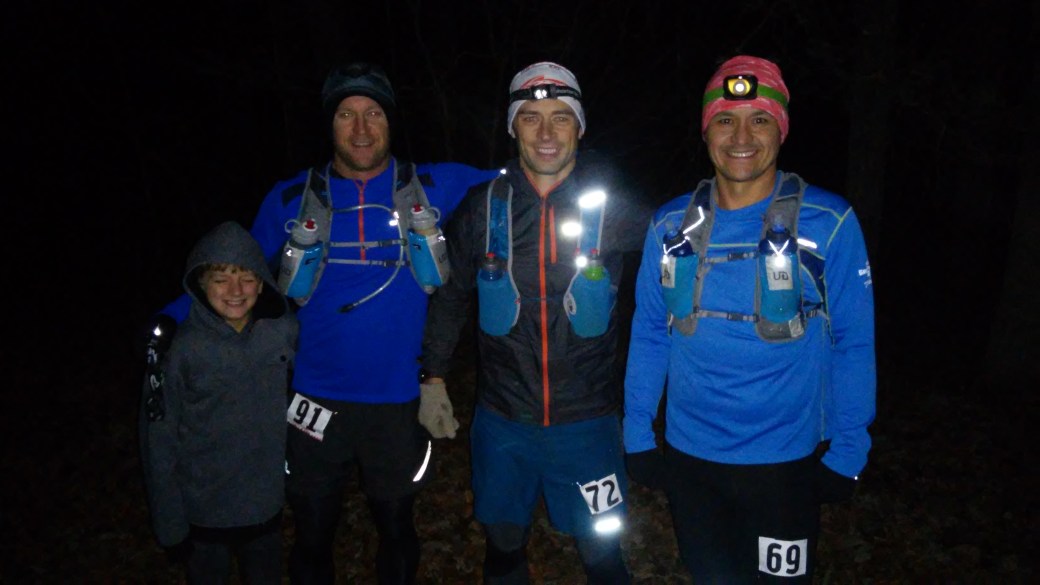
11:59pm at the start! Tyson (Jason’s son), Jason, Me, Carter.
//
Below is the course profile, which might be helpful as a reference to follow along below.
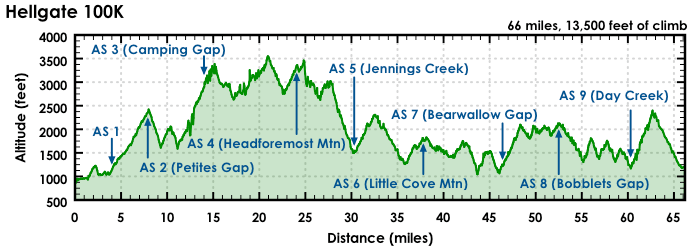
The first 7 miles of the race are uphill, relatively gradual, from the valley to the Blue Ridge Parkway. About 15 minutes in, the coffee took effect and the bowels woke up, and I stepped off trail into the woods to release a brown bear into the wild. I was glad to knock that out early.
Ran-walked most of the dirt road up to the Parkway crossing, talking with a few folks along the way. The night was crisp-cold and very clear. Looking up the mountain you could see the train of headlights, which was sometimes hard to discern against the backdrop of bright and clear stars. The parkway crossing was also Aid Station 2 (AS2 – Petite’s Gap) which I ran right through. It was still early, I was fresh and didn’t need anything.
Petites Gap to Camping Gap (AS3) was pretty fun. The first half was technical rolling single track, and I fell in with a train of about 6 other runners and we had a good group momentum through this section. This single track dumped out onto a dirt road that climbed up and up for about 3 miles to Camping Gap Aid Station. I caught back up with Carter during this section, and we came into aid station together.
Camping gap was where the cold was first really apparent. They had a fire going, and after taking in some broth, a few pretzels, and a Vespa, I tried to warm my hands and thaw one of my water bottles. Trying to thaw the water bottle turned out to be futile – I ended up carrying two bricks of ice on my chest for the rest of the race.
Leaving camping gap – we were now on the E side of the ridge, exposed to a wind which magnified the cold. The section was not technical and pretty runnable, but the cold was taking effect. Core temp was ok from running, but hands would not stay warm, and face appendages were frozen. Legs felt good, but the cold was causing some hip-flexor pain. Again I tucked in behind a group of 3 that was holding a pace I liked, and stayed with them most of the way to Headforemost Mtn (AS4) at ~mile 24, the first of two drop bag access points.
I had decided prior to arriving at AS4 that I would change out socks with a fresh pair from the drop bag. Feet were wet from a few creek crossings in the first few miles of the race, and although feet weren’t really cold, I wanted to get fresh socks on to mitigate future blisters or foot issues. This was a good idea in concept, but turned out to be a mistake in practice. *Disclaimer: the following is probably one of the longest aid-station recaps you’ll ever read, but it was a key event in the race to me.
I came into the aid station, found my drop bag and sat down to change socks. Within seconds after I stopped running – I could feel the cold penetrating throughout my body. One of the aid station ladies said it was ten degrees, and I’d guess that with the windchill at times it was in the low single digits. I went to take off my shoes but the laces – which were double knotted – were balls of ice. My hands were about useless, as the muscles in my hands and forearms were cold-paralyzed. I asked an aid station volunteer for help with the laces – they found a screw driver and went to work while I pulled a fresh pair of socks from my bag. It took a while, but the volunteer eventually got the laces undone and the shoes off, and I tried to put on my fresh dry socks. Imagine trying to pull on socks using a mannequin hand – that’s essentially what I was doing. It took forever – all the while my ungloved hands were getting colder and stiffer and my unsocked feet were catching up to my hands. After I finally got the socks and shoes back on I had to ask for assistance to tie my shoes. I stood up and went back over to the food table to eat real quick before heading out, and saw Carter there – he had arrived while I fumbled through my gear. I tried to grab some pretzels but my hand-claw couldn’t pick them up and dropped them all over the table. I was also shivering violently – to the point where I couldn’t really talk clearly- so I decided I’d better abandon pretzels and get going. Thankfully Carter was ready to go and we left the aid station together.
Leaving that aid-station was one of the coldest experiences of my life. My legs still worked fine for running – but they were about the only things that worked. I was cognizant enough to realize that my mental clarity was declining and I was probably starting to get hypothermic. Carter and I talked a little bit but it was tough, my frozen face muscles and fuzzy brain made conversation difficult. It took a few miles for me to warm back up and pull myself out of that state. That aside, the section from Headforemost Mtn to Jenning’s Creek ended up being some really good running – we fell in behind another group of three and we had some fun miles of downhill single track.
Jennings Creek (AS5) was a quick stop for food and water, and the group split up as we left. I was no longer uber-cold, but it was still just as cold out. The section after Jenning’s Creek started with about 4-5 miles of dirt road, during which time it became light out and headlights were turned off. I was alone through this whole section, but it was nice to see the transition from night into day. The next aid station, Little Cove Mtn (AS6), was small and on a wind-exposed section of road. The pickles at the aid station were frozen – that really jumped out at me. I’ve never tried frozen pickles…maybe I’ll have to try sometime, but this wasn’t the time.
Legs were really starting to get tired at this point – along with a general feeling of exhaustion. Not too much to report on the next section to AS7, other than it was long, and had some really difficult technical leafy sections. I think it was somewhere in the 8-9 o’clock range, and for the first time all race I was occasionally feeling warm, when here and there the sun poked through the trees. There were some cross-hill singletrack portions of this section that were so treacherous with rocks and shin deep leaves, that even walking them was challenging. Every foot placement felt like a roll of the dice, but somehow I managed to stay upright throughout.
Bearwallow Gap (AS7) at ~mile 47 was the second drop-bag access point – and I had less ambitious plans this time. I dropped off a thin beanie that I’d been wearing over my buff, and threw some calories in my mouth and in my pack. As I left my drop bag, Carter came in only a few minutes behind me. He said he was going through a really rough spot mentally – that the last section had been a dark place for him. I tried to offer words of encouragement, but didn’t have much to offer since I was in kinda the same boat. I stopped at the food table for a quick sec, where a guy had a grill going with burgers. I ate a glorious half-burger fresh off the grill and washed it down with hot chicken broth. I left the AS in close proximity to about 5 other runners, and we stayed somewhat together for a few miles. Being around others at this point in the race is nice – the group serves kind of like a pacer for each of the individuals in it.
Once the group dissipated, some pulling away and some falling back, I fell into a real low point. Going on almost 30hrs of no sleep (except for the short hotel nap), the eyelids were heavy and I even as I ran I was feeling the effects of sleep deprivation. Legs were heavy. I took position behind a guy who was going at a pace I felt I could sustain, and just held on. It wasn’t fast, but we were still running the flats and downhills, and staying with someone removed some of the mental effort of just keeping going. This was around the 50 mile mark, and the section was sustained single track that contoured along fingers and ravines on the west side of the mountains.
If you read my pre-race blog entry you’ll recall that I had said “I’m not worried about the extra 16 miles.” Well – I probably shoulda been. My inexperience shone through in my pre-race naivety…an obvious lack of understanding of the combined effects of terrain, distance, and conditions. And the 13 hour goal?! I guess hindsight is 20/20, but apparently taking your earlier results from 50 milers and extrapolating out a 100k estimate does not work on this course. I’d had to let go of this goal several hours ago at this point. That said – I do believe I’m capable of it, and if I get to race in Hellgate again in future years, 13 hours will remain as the mark on the wall to shoot for.
Back to the run. The guy I was running behind was apparently having a hard time too, so I passed him and continued on solo. This took me into Bobblet’s Gap (AS8), still feeling really run down. I had a some hot chicken broth, and as I drank it I remember saying to the aid station guy “This is really starting to suck” (the run, not the broth). So much for positive mental attitude! Before I left, I asked if they had any coffee. They didn’t have any out on the table but one guy had a personal thermos in his bag, and he poured me a cup of hot black. This was a gift from the heavens! Much appreciation to the aid station crews, they stood out in the cold all night and/or morning, and went out of their way to help run-drunk people like me. I can’t say the caffeine had much of a direct effect, but psychologically the coffee was amazing. It should be standard at aid stations late in long races.
Left Bobblet’s Gap knowing that only one more aid station and about 14 miles separated me from the finish. The first 3 miles out of the aid station were gentle downhill fire road that I welcomed. The good times were short-lived though, when the course markings took me off the fire road and up a hillside on deep leaf singletrack. Crested a ridge and was heading down the backside when I heard someone coming up on me fast. I looked back and saw Carter tearing down the trail behind me. “I guess you’re feeling better” I laughed. “Come on, let’s go,” he said as he blew past me, trying to motivate me to pick it up and stay with him. This worked for about 20 seconds, then I had to let him go. Carter is really strong on the downhills, and he was flying down this downhill section like it was the first 10 miles of the race. He had gotten a serious second wind, and was now moving fast back up through the field. Within 5 minutes, he passed the next guy in front and was out of sight. I was actually really stoked for him – I was glad he was having a strong rally and had pulled out of his low point back at Bearwallow Gap. Carter wasn’t the only one who passed me in this section – in fact I probably lost about 6 positions, but at this point position in the field wasn’t a high priority of mine.
I came into Day Creek, the last aid station, and was in and out pretty quick. The light at the end of the tunnel was off in the distance, about 6 miles away – 3 up, 3 down (see course profile). We had to go back up the mountains, cross the blue ridge parkway, and then drop back down to the finish at Camp Bethel. I hiked the 3 miles up, but I tried to keep a fast hiking pace. Crossed the blue ridge at the top and ran the last section down a fire road into the valley and into Camp Bethel.
It’s an amazing feeling to come into the finish after a long tough event like this and see your wife and baby daughter at the finish line. They missed a few this year, but being there at the end of Hellgate more than made up for it. I picked up my seven month old daughter Finley as I went into the finish chute and ran the last 25 yards with her across the finish line. She gave me the look that said “What’s the big deal?” Ha! – you’ll know someday. I crossed the line at 14:24. Dr. David Horton, Hellgate founder and race director, welcomed me in. I gave him a big hug and thanked him for the event and my inclusion in it. I was still a little out of it, but overwhelmed to be done with the race, and just soaked it in for a few minutes. What a day.
Carter had finished in 14:04. Jason injured his ankle about 20 miles in and had to drop, but he was there at the finish line, and took the below photos. Full results from the run are posted here.
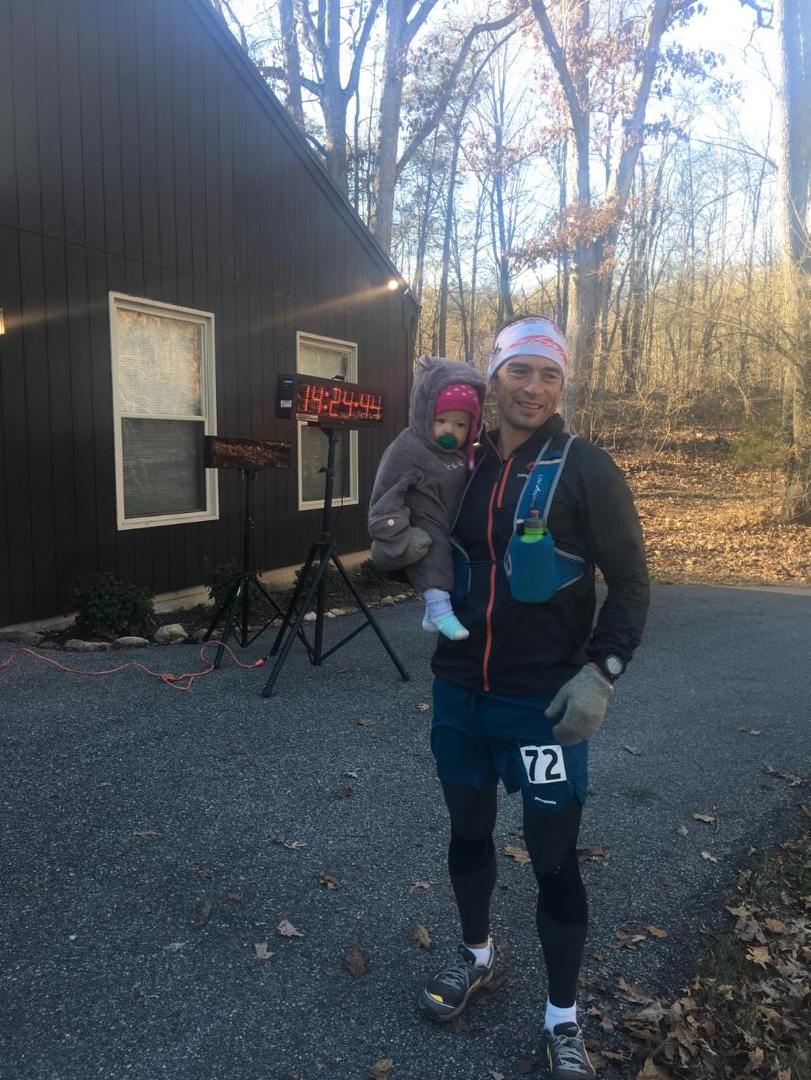
With Finley – just crossed the finish line
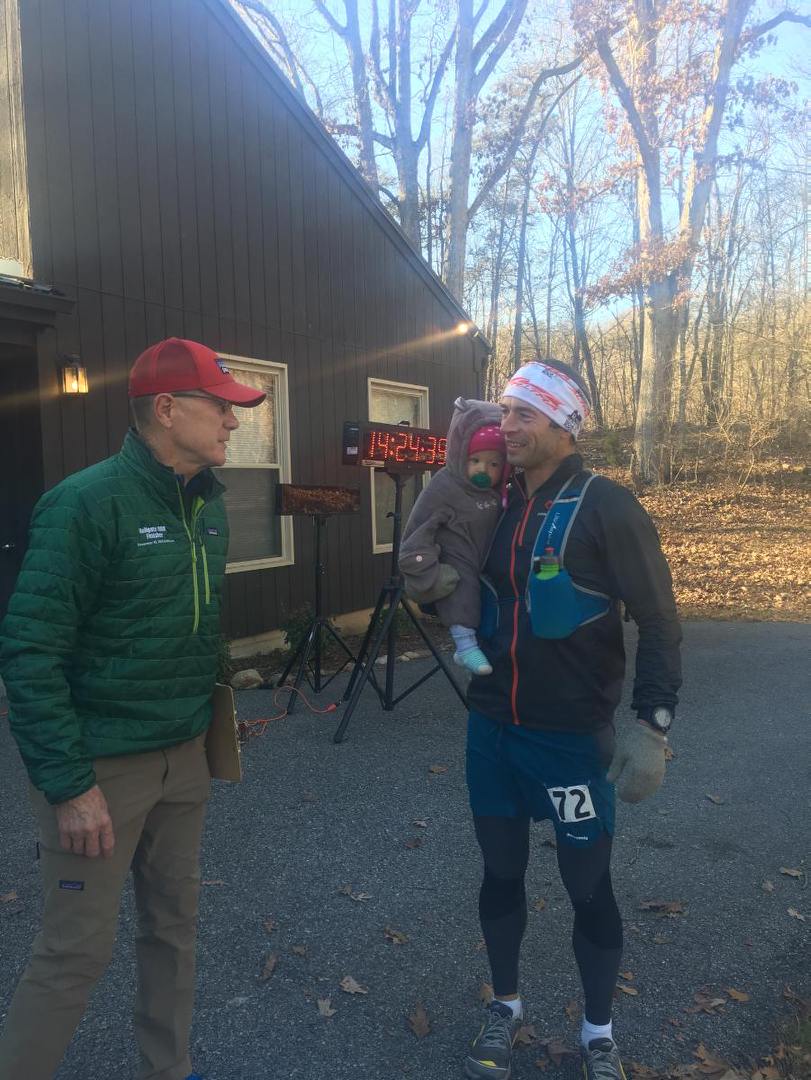
Talking with Dr. David Horton, Race Director
//
Takeaways/Reflections
I’ve broken these into two categories: tactical and strategic. Tactical are the smaller, more running-specific points/lessons that I or anyone can apply to other races. Strategic are the bigger picture takeaways – things that have larger implications and/or applicability than just ultrarunning.
Tactical:
-Long AS intervals: There were 9 aid stations total, but in reality only 8 effective ones, cause AS1 was 4 miles in and I’m not really sure why it’s there…you shouldn’t need aid 4 miles into a race. So with really 8 aid stations, the average gap between aid stations in Hellgate was about 8 miles, with the longest section about 10 miles. As a comparison – Mountain Masochist 50 miler had 14 aid stations, Run Rabbit Run 50 miler had 8, and most road marathons have 10-15. So these sections between aid stations were relatively long – both in distance and in time. If this were a summer race, hydration would be a big issue, as you can easily drink more water over that distance than most people carry. With my bottles frozen, I had to force myself to drink water at the aid stations, as the cold masked my thirst perception. More importantly, from a mental perspective, these intervals made for some long and lonely sections, which in turn create a bigger time-window opportunity for negative thoughts to creep in. There’s a much stronger sense of being out on your own far from aid, which I think definitely contributes to the event’s reputation as a tough race.
-Cold effect: I don’t think I was the only one who can say I underestimated the impacts of the cold. Aside from the immediate effect of just making you miserable, it is also a big energy drain, which I really believe was a major factor in overall fatigue later in the morning even after it warmed up. Thicker gloves were needed, and maybe even one more thin top layer. The frozen water bottle issue – I don’t know yet how to solve that one. I saw some guys that had their windbreaker over their bottle vest…maybe this would help trap body heat around your bottles and fend off the ice, but probably only temporarily. I suppose that if you just drink often, the regular movement of water through the water bottle would prevent icing. What happened with mine though, was that the nozzle itself was the first to freeze up, rendering it useless. Early on I could have still unscrewed the cap to drink, but that would have involved some hand-dexterity, which was in short supply. This leads into the next topic….
-No-hands effect: A by-product of the cold-effect. I wore some light wool mittens that I’ve used with no issue in the past – including backcountry AT skiing in the mountains of British Columbia in February. They weren’t cutting it at Hellgate though. After AS3, I put some Goretex overmittens over them to add another layer. These overmittens did nothing – if anything it was worse with them on because I couldn’t blow through the wool onto my hands to warm them with breath. I ended up balling my hand up inside both gloves, which ruled out performing basic acts such as grabbing water bottles, grabbing branches, adjusting headlight, etc. I could take the glove combo off if needed, but putting it back on was a struggle, so I pretty much kept them on. This caused me to not do the little things I should have been doing, like trying to drink, or pulling gels out of my pockets, or adjusting my buff to cover my ears, etc etc. It wasn’t till about halfway between AS4 and AS5, when Carter gave me some hand warmers from his gloves, that my hands warmed up to the point of serving their purpose.
-GPS: I read another blog recap of Hellgate in which the guy said he hadn’t carried a GPS, and was glad he didn’t. Carter didn’t use his. Having real time data on your wrist makes it very accessible and tempting to monitor constantly – which can screw with you late in a race. As you start counting down miles to the finish, watching your mileage counter is like watching water boil – they pass agonizingly slowly when your watching them the entire time (or, more likely….I’m really going that slow). If I run this again, or another similar long race, I will keep my GPS in my pack, vice on my wrist. That way I can get to it if needed, but it would have to be a deliberate decision. I do still want to collect the data, it is good to analyze later.
Note: I was using a new GPS watch that I bought just prior to this race. My old one was fine, but its battery life limited it to races of 9hrs or less. The new one, the Garmin Fenix 3 HR, has a built in heart rate monitor that reads off the wrist, a 16 hour battery life, and tons of other stuff that I don’t even know about yet. Kinda pricey, but worth it I think.
-Drop bag: I failed at drop-bag organization. Nothing was where I thought it was in my bag, the least necessary items were on top, and the bag was full to begin with so I couldn’t offload gear. If I’d had room in the bag, I would have ditched my ice bottles and maybe my whole vest at AS7. Fail.
-Body systems check: I’m not quite 48 hours out from the race, and all things considered the body feels pretty good. The legs are obviously sore, but its normal soreness and no specific joint or body part is exceptionally painful. The feet bones are a little bit tender, so I’ll be wearing soft soled shoes for a few days. Interestingly enough, in the month leading up to the race my big concern was my left knee patella tendon, which had flared up just prior to MMTR and re-aggravated at the Richmond Marathon. The left knee was a non-factor the entire race, and actually the right knee gave me more pain than the left (although still very low level pain). Two days out, the skin is still numb on the back of my thumbs, from the thumb joint down to the inside wrist bone. I think this is residual from the cold, and feeling will come back over the next few days. Interesting though.
As planned – I am taking about 6 weeks off from running. I think the 6 weeks will be good for the body as a whole, and allow me to spend time doing other things that I’ve put aside for a while – jiu-jitsu, house projects, mornings with the family, biking, maybe some paddle boarding, etc. Come late january though, it’ll be time to start building the mileage base again, for some fun races in the Spring.
——–
Strategic (some of these are probably cliche in ultra running circles, but I’m still new to it and, well, it’s my blog)
-Inner dialogue: You end up having a lot of interesting conversations with yourself during a fourteen and a half hour run. Topics range from the absurd to the profound. One that comes up a lot is the “why am I doing this?” question. It’s rhetorical really, cause the answer doesn’t really matter – you really just need to keep going. But regardless, it’s an interesting dialogue.
In the moment, the fun is hard to find. In the moment, doing another one of these in the future is unthinkable. In fact – I bet if the only place you could sign up for Hellgate 2017 was at the last aid station of Hellgate 2016, Dr. Horton would probably have approximately zero entrants (maybe a few crazies). Interestingly enough though, even though it doesn’t feel like it, deep down somewhere you’re enjoying it. You know the feeling that’s waiting for you at the finish, the feeling that is inversely proportional to the level of suffering you’re going through at the moment. And every once and a while – you look around and realize where you are, and see the people you’re with. Everyone out there is going through some level of the same thing.
There’s also another answer to the question that came to mind. True tests like this bring about a state of being that is unlike anything in our day to day lives. There are no shortcuts to this state…..there is no pill or yoga pose that can get you there. You must push yourself to and through suffering, wrestle with your psyche, and stare your vulnerability in the face. In my opinion ultra-running is unique in that this is an integral and almost expected part of the sport.
**The best articulated discussion on this topic, and the meaning and goodness that one can extract from it, is from Andy Jones-Wilkins in an interview after his Hardrock 100 this past June. Here is the link [https://www.youtube.com/watch?v=gYx4wv3yCIQ] – start at 32 min and listen to 1 hr 20 min. *Note – I am by no means equating my 14.5 hour Hellgate run to AJW’s 42 hour Hardrock experience. They don’t compare – my Hellgate experience just gives me a new perspective and appreciation of his points.
-Competition: My competitive side never completely went away, but it was pretty subdued by about 40 miles into the run. Occasionally, I would wonder about where I was in the field, but it was more out of curiosity than concern. By that point I was truly running my race – usually this is my strategy in the first half, not the second. As I was getting passed in the last miles, I was actually happy to have a few folks to run with for a few miles, rather than upset at losing positions. When Carter passed me, my competitive side stirred momentarily, then relaxed and was replaced by contentment and happiness that he was doing well and would be at the finish line when I came across.
I will say that I continually adjusted my time goals along the way, which fluctuated between 13 hours early on, up to above 15 hours during the dark miles, to 14 hours at some points, and eventually settling out at 14:30. If you listen to AJW’s interview referenced above, he talks about having to let go of every goal as his race went on…to let go of everything besides just putting one foot in front of the other. Well I didn’t get quite to that point, but I definitely had to release, re-assess, and adjust my expectations and goals as the day progressed.
Another takeaway from this is that the competition of a race has many levels. Competition against the field, against the clock, against doubt and the inner demons, against physical pain. These are all noble competitions – and often happen in parallel. Sometimes however, when you get broken down, you can only fight one battle at a time.
-Gratitude: I’m repeating this topic from the pre-race blog, cause I have new things to be grateful for, and I learned some things that put it into a different perspective.
First – IRT to getting selected for the race – I found out that I was even more fortunate than I had originally thought. Not just fortunate, but lucky (I think those are different, right?). After I was finished, Dr. Horton informed me on how I’d gotten my spot. After he made all his selections to the race, he had a thick pile of entrants that he deemed would be in way over their heads at Hellgate. He then drew one name from that stack for the last entry spot. Well, apparently I was in that stack, and I was the name drawn. It sounds too good to be true, but I believe him, as he announced it to the room full of runners as I was leaving the room to head home after the race. Amazing. And thank you again, Dr. Horton.
Second – The aid station volunteers. I think I may have mentioned earlier that it was cold. These guys and girls were out in the middle of nowhere all night in the stuff. Granted they were dressed like Eskimos, but they didn’t have running to keep them warm. Grilled cheese sandwiches at almost every aid station. Chicken broth – just the right saltiness and temperature to drink down quickly and warm up the core. Jenning’s Creek aid station needs its own Yelp page so I can give it 5 stars….maybe just four, cause they had turkey bacon instead of real bacon. At mile seven near AS2 I passed a shark and a banana dancing on the side of the trail…..if it had been 40 miles later I would have written it off as a cool hallucination. But no – it was really a shark and banana dancing on the side of the trail (technically, it was two people in shark and banana costumes…relax).
Third – I am grateful now that I had a hard, trying race. If I hadn’t – if I’d of had another day like MMTR, then I would have closed out 2016 without having experienced an important side of long distance running. I realize now that I hadn’t had that in my four earlier ultras this year. Promise Land 50k in April was probably the closest to it – it was really tough for the last 8 miles. But it was different, not as pronounced. Hellgate exposed me to a deeper level. I recognize that suffering is a spectrum and many have been much much deeper than I was, but I’m grateful that I was tested. And I know I will be tested again in the future, even moreso.
//
Well if you’ve made it this far I commend you. I write these blog entries as much for myself as for the reader, and this one was very worthwhile and meaningful for me, and fun to write. I hope you were able to get something out of it, and maybe get some insight into my Hellgate 2016 experience.
Next blog topic: A look back at 2016. Will post by the end of this month.
 bradswebblog.com
Great stuff! Sometimes it’s pretty good to get broken down a little by a race. It makes the good races feel that much better! I’m imagining this race destroys a lot of people too. I don’t know what to do about freezing bottles, unfortunately the answer is probably not running ultras when it’s 10 deg F. At The Bear I had an aid station worker give me the disposable hand warmers for inside my mittens. Those saved my hands and will be in my drop bags for any future cold races, granted Bear was not that cold but it was wet. Lastly, I Second the no gps idea for long races, I use a timex for long ones. It gives me more mind games to play too, not knowing the distance and estimating it for each section instead.
Greg
LikeLike
Great picture of you, Finley, and Dr. Horton!
LikeLike
You are one in a billion! Kudos to you for finishing this event in good spirits and intact body.
LikeLike
Pingback: 2016 Year recap |