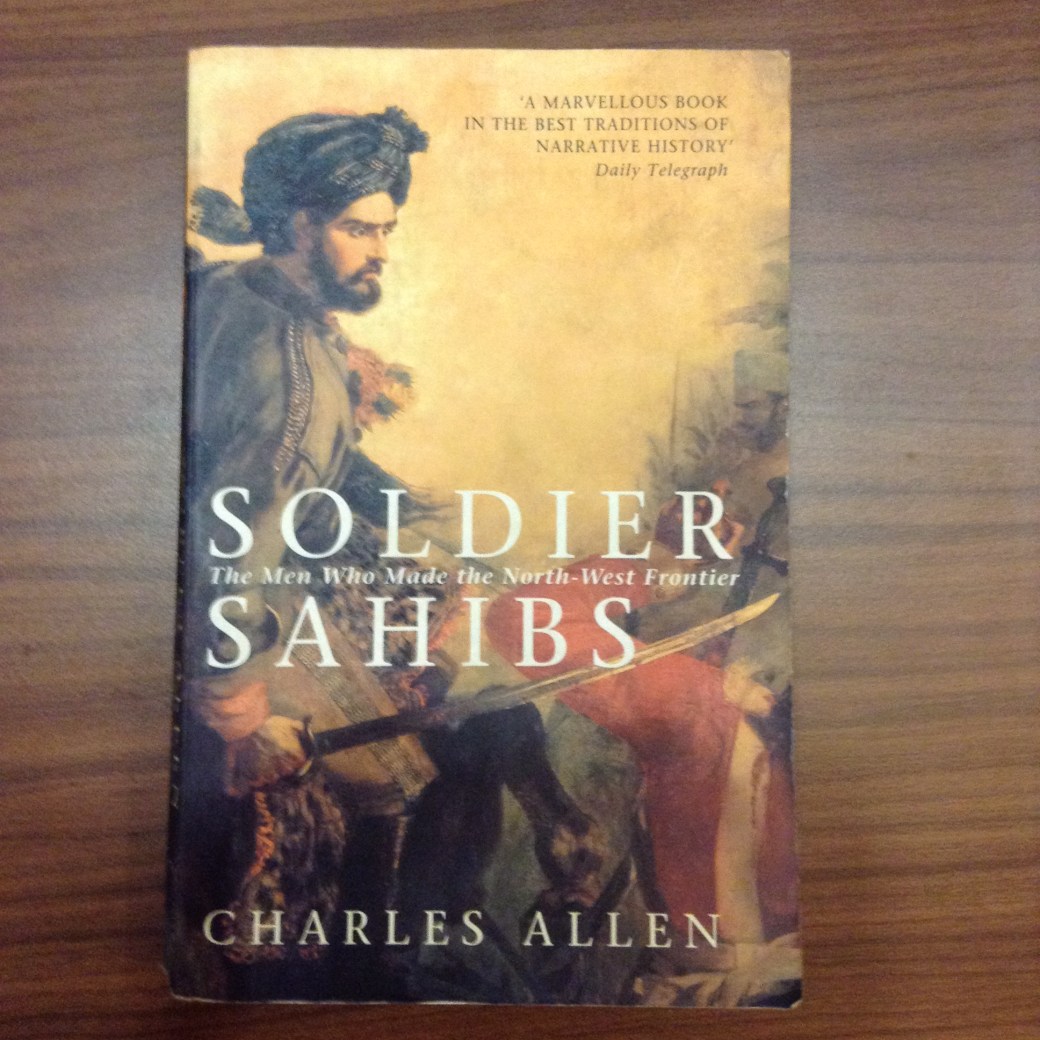
Publisher is Abacus. Copyright 2000. 341 pages plus intro.
Why I read it:
Recommended to me originally by a boss/mentor about 9 years ago. I bought a copy shortly thereafter but it sat on the shelf for many years. Then back in August, someone else – someone very well read on Afghanistan-Pakistan-India history and geopolitics – said it was the best book he had found on the mid-19th century history of India (which included what is now Pakistan).
What it’s about:
The time period it covers – roughly 1830 to 1860 – was the heyday of the British East India Company’s campaign to control the region. India at this time was rife with different ethnic, religious, tribal, and warlord tensions and conflicts. To manage it’s territory, the East India Company (EICo) developed an army of it’s own, which was sort of a hybrid commercial-national military. Members of this service were India specialists, as they served in India almost exclusively. They were not deployed or even stationed there; they lived there for their whole careers. The book tells the story of the Sikh Wars, the Northwest Territories, and the Siege of Delhi, through the careers of eight prominent officers in EICo.
Most prominently featured in the book is John Nicholson – a larger than life British officer known for his tenacity, courage, combat leadership, and an almost (but not quite) insubordinate disdain for authority. Others include Neville Chamberlain, James Abbott (for whom Abottabad is named), Henry Daly, Herbert Edwardes, Henry Lawrence, William Hodson, And Harry Lumsden, amongst others. Most of these are not household names, at least outside of England, but we learn a bit about each of them – their strengths, shortcomings, squabbles, and sometimes a peek into their personal lives.
The good:
- Appreciation for what one may consider ‘counterinsurgency done right.’
- Thoroughness of research. Charles Allen utilizes primarily original sources as references for the detailed accounts of the events. He often reference and quotes letters written by the EICo officers themselves
- Wide and shallow. Covers a broad swath of history and events. Each conflict/episode could be a book in itself, but the author effectively covers the key events and dynamics
- We get a look into the British Soldier mindset. They’re identity is strong enough to avoid the temptations of going native. We also see here and there their sense of humor, what worries and concerns them, and an odd tendency to downplay what most would consider serious injuries.
The not-as-good:
- The book should include some sort of character map. There is a lot of bouncing between individuals, and many of their names are somewhat similar (for example, their were three Lawrence brothers all serving in India at the same time). Given that none is provided, I would recommend the reader develop one as he/she reads. The story does bounce around a bit, and the reader can easily lose track of locations and personalities.
- There are geographic maps in the book, but they are too large scale to really follow some of the events. Some more detailed insets would have been helpful (there is one provided for the siege of Delhi, but that’s the only one).
- Would like to have balanced the British view with more of a perspective from indigenous leaders (Sikh, Hindu, tribal).
- The story focuses on the people, military elements, and decisions. I would have like to have more of a sense of the physical surroundings (what was the terrain like, and how did it affect the soldiers?), and maybe some more about the local societal and human factors that the soldiers faced. In fairness, Charles Allen is at the mercy of the original sources he used, so perhaps this info is simply not there.
Takeaways:
- Being a soldier back then took a different level of commitment than today. When you signed on the dotted line to work in the EICo army, you essentially signed up for a life in on what we would consider deployment status. These gentlemen built their entire lives on the front lines. Once every five years or so they’d go back to England, usually to find a wife and marry. Then after a few month too a year, they’d return to India and go right back to the dangerous border regions. Getting dengue or dysentery or other similar illnesses was just considered part of doing business. And when soldiers would get reassignment orders within India, they were on their own to get there. In other words: if the orders said “report to XX garrison in Peshawar,” it was on you to get there. And this usually meant walking several hundred kilometers through unfamiliar territory.
- As mentioned above, we get a glimpse of an effective (usually) counterinsurgency campaign, which proved itself time and again in stamping out unrest and rebellions to maintain stability. I believe EICo’s success stems primarily from several factors.
- First – their success depended on maintaining credibility and the trust of some ruling local faction, not in flowing in large number of soldiers or resources. On average there would be 2-3 Brits responsible for governing an entire region. These soldiers had to be almost completely self reliant; there was no resupply or reach-back support available, at least not on any kind of responsive timelines.
- Second – turnovers and rotations generally happened only if/when someone was killed or fired. There was no time-based rotation of people through positions. When a soldier took responsibility for a region, it was his indefinitely. This alone forces a level of investment and ownership that is rare on timed rotational deployments.
- Third – they adopted local customs in how they administered governance and justice. Often this meant strict punishments, discriminatory policies, or other measures that would not fly in today’s more closely controlled and regulated wars. In general though, they created hybrid forms of governance, adopting local institutions and processes where effective, and adding their western flavor when it helped. This is not a normative statement – I’m not advocating that we should return to this unconstrained form of counterinsurgency – but at that time and place in history, it was effective.
Conclusion/ Recommendation:
This is an interesting history read, well researched and surprisingly thorough. I can see why it is considered a must-read by folks with extensive background in the Afghanistan-Pakistan-India region. I would recommend it for history fans and especially those who may have either personal or professional interest this region. It provides a solid foundational understanding of the events that shaped the course of history in this part of the world. However, don’t expecting a comprehensive regional history – it is very specific to the role of EICo during the early and mid-nineteenth century.
 bradswebblog.com