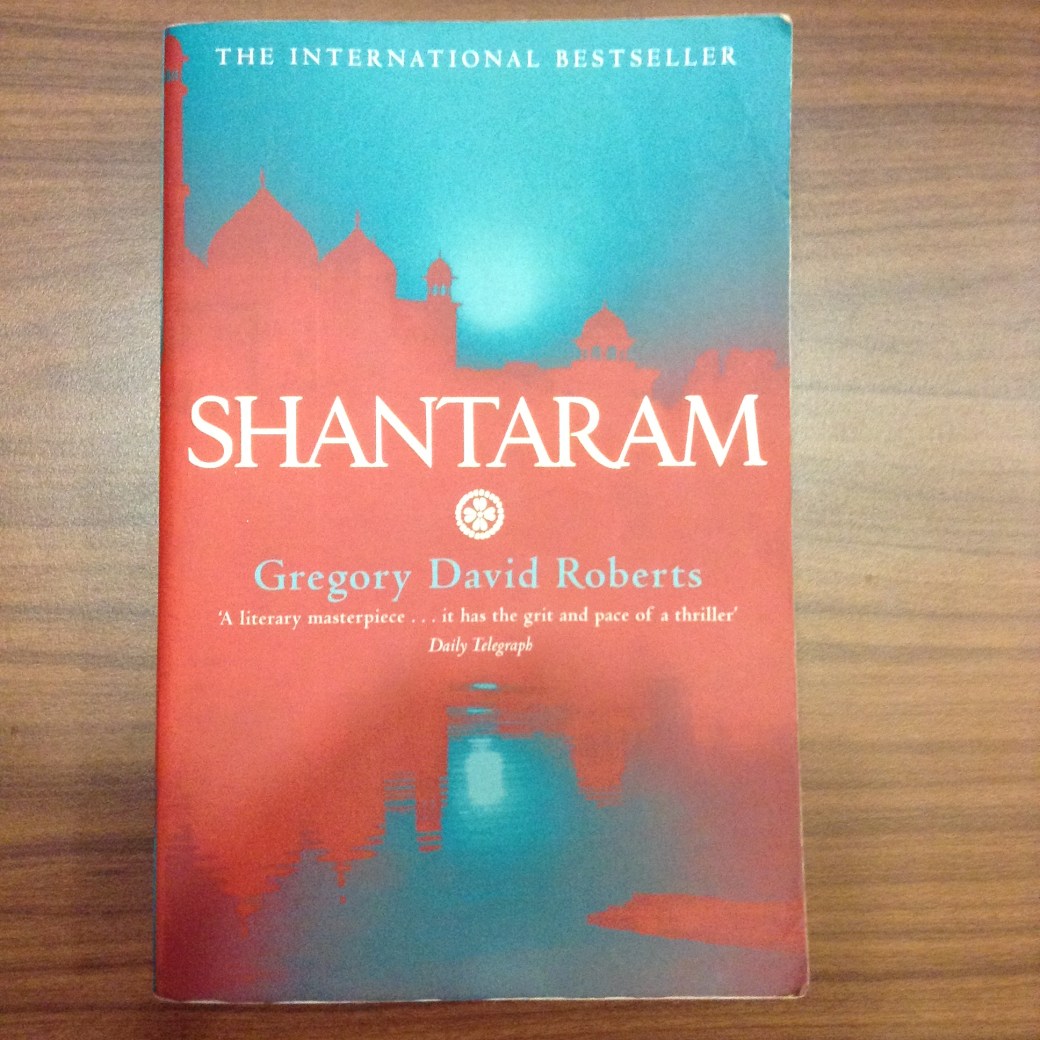
Publisher: Abacus. Copyright 2003. 933 pages
When a book is recommended to me by several people, independent of each other, I take notice. Such was the case with Shantaram, by Gregory Roberts. The seed having been planted, I found a copy on the loaner bookshelf at work and dove in, not really knowing what it was about other than what is written on the back cover (which is often the case, and often the best way to get into a book).
I don’t know what qualifies a novel or story as an “epic,” but Shantaram probably meets many of the criteria. It took me about six weeks too read, as it’s over 900 pages long. While the story is for the most part told on a single continuous timeline, there are many interwoven subplots in the protagonist’s life. It is told in the first person narrative form, the author recounting a transformational and adventurous period of his life.
In short, the protagonist ‘Lin’ is an escaped convict that arrives Bombay in the early 80’s with no plan and no strings attached. As a man without any anchor or foundation with which to depart from or fall back on, he dives into (aided by some events along the way) and becomes enmeshed in several of the various subcultures – often illicit – of the city. The overlap and intersection of these subcultures is the through-line which holds the many sub-plots together over the course of 4-5 years.
I’ll try not to give too much away; I don’t want this reviewt to be a spoiler. Instead, here are just a few thoughts as I look back on it (I’m about a month removed from finishing it). In no particular order:
- There are a few lulls in the book, but be patient. Reading the story can be like being in the surf on a long-period wave day: periods of relative calm in between plot surges. Just as you start to feel complacent and maybe a bit bored, the next big wave hit you and tumbles you along for a while. The point: don’t despair or give up when it starts to slow down. Give him some time, and Lin will get into some shit. The wave will hit and you will go for a ride.
- A few sections that really stood out to me [these are deliberately vague]: Lin’s experience living and serving as a doctor in a slum for ~six months. The economics and inner workings of the Bombay mafia. The philosphizing and wisdom of Lin’s father figure Khaderbai. The Afghan campaign. The tenuous mix of mystery, obsession, and tension surrounding his love of Karla. Lin’s account of a multi-week heroin binge and the absolute horrors of withdrawal.
- I suppose the central question to the story – at least in my mind – is this: What is Lin trying to find? Is he running towards something, or away from something? We get only glimpses of his pre-Bombay life; we know he was a husband an a father, and then fell into the dark world of drug fueled crime. When he escaped prison in Australia – he was both haunted and free. Haunted by his past and the possibility of it catching up to him, and free from any contraints of civil society. As a criminal on the run, he inherently lives outside the law. So what does he look for and find in Bombay? Early on – I think he seeks some semblance of normalcy. He finds this in a motley crew of friends, all with different types of skeletons in their closets. Then one by one we learn of the objects of his ongoing search: purpose, belonging, a father figure, love, and meaning.
There is one glaring hole in this list: Lin never discusses or goes into depth about his spirituality. I use that term generically to refer to the idea that there is something greater than this reality that we experience day to day. He carries with him an air of skepticism, but why? Lin is obviously searching for something larger, but he never considers pursuing a spiritual path. Despite surrounding himself with individuals of different faiths and going through literally life-changing crucible-type experiences, Lin relies on his inner strength and interpersonal relationships to get through. Never (that I remember) does he fully consider a higher power or transcendental reality. I would have been interested to hear him discuss his thoughts. Why, when those around him prayed, relied on faith, and spoke with conviction of their religion and spirituality, did he keep it all at an arms distance?
- Is it a true story? The info on the book’s back cover is vague. I could tell while reading it that there was some level of fiction….no one’s memory is good enough to recount the level of detail of which Roberts writes. But the question I wanted too know was how much of it is true. I deliberately waited until I was done before I looked it up. According to online references, it is a fiction novel based loosely around the author’s experiences. The characters and dialogues and micro-events all are probably only partially based in reality, but it’s plausible that the macro level plot line is based in Roberts’ real experiences. The line, however, is blurred, and it would be interesting to hear Greg Daniels’ speak or read a (shorter) version of his no-kidding real life story.
Recommendation:
If you are up for taking a long journey, this is a good one to take. I’ll caveat that perhaps it resonated and was more interesting to me because I read it while in India, and I experience first-hand many of the cultural observations that Lin makes. Every day in Delhi, I see the same hustle bustle of life that Lin describes in his experiences in Bombay. In this way, I think it is a fairly accurate portrayal of Indian society, at least on the surface.
However, you don’t have to be in India or have been to India to enjoy this story. It is a page turner…it moves you along and you develop a relationship with Lin. My sense is that he is very honest with the reader throughout – and is not shy about exposing his vulnerabilities and weaknesses.
Commit yourself to it when you start it. Realize that there will be lulls in between plot waves, but when those set waves come in, you’ll go for quite a ride. It’s a long but exciting and rewarding story.
 bradswebblog.com