Man, it felt good to race again!
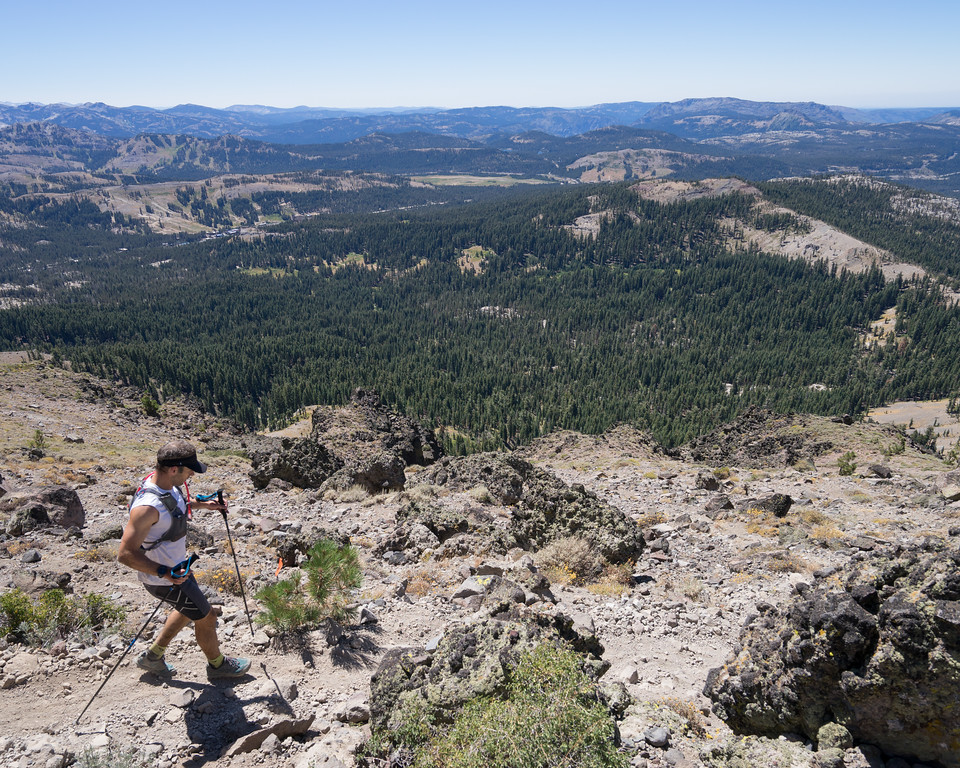
Descending Castle Peak, ~ mile 35. Photo by Bill Stevenson
Race info at a glance:
Location: Donner Pass, CA
Route: Point to point. Start at Prosser Campground just north of Truckee, finish at Sugarbowl.
Date: 18 Aug 2018, start time 5:00am
Distance: 100 km / 62 miles
Cutoff: 22 hours
Surface: 93% singletrack, 5% dirt road, 2% pavement (my estimate)
Vertical gain: Race website estimates ~15000 feet. My garmin recorded 12,664. Average elevation 7,300 feet above sea level. High point ~8900 feet.
Wx: Sunny, hot, dry
Starters: 143
Finishers: 108
Wildfire smoke?: No
Result
Time: 13:42:21
Place: 15th overall
Even though I didn’t have a strong finish, I’d say this ranks up there with one of my better races. Definitely one of the most memorable. Things just kind of came together for me last Saturday. And on top of the events of the day, the satisfaction was amplified by the injury and uncertainty that I’ve had to work through the last few months.
This year’s race was bigger and improved from the previous year. There were more runners, and a slightly improved (aka more difficult) course. Starters increased from 80 to 143, and finishers increased from 59 to 108. It is worth noting that while the finishing percentage between 2017 and 2018 were very similar (73.7% vs 75.5%), this year the race added two hours to the overall finish cutoff (20 to 22 hours), and 21 of this year’s 108 finishers finished in that extra two hour window. Those 21 folks sure got their money’s worth.
I think Castle Peak is exceptional even in the mountain ultra trail running community. It is a true rugged mountain trail race. My prediction is that this event will continue to gain notoriety and popularity in the coming years, through word of mouth of those who know firsthand what this course brings to the table.
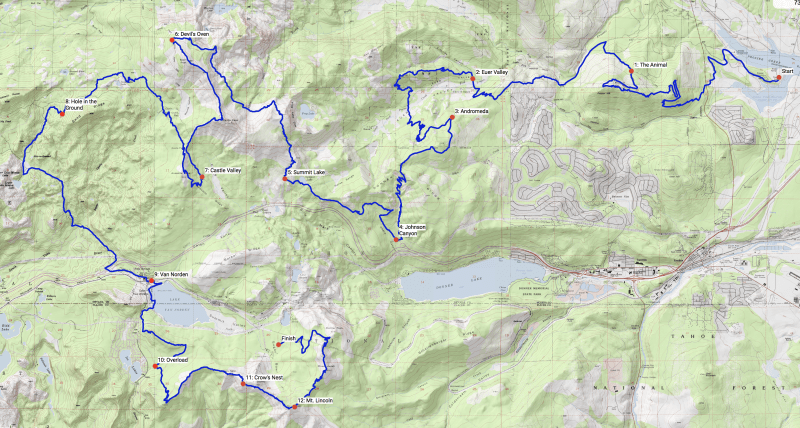
Castle Peak Course, with aid stations labelled. From www.castlepeak100k.com
I went into this race with a simple strategy (for details, see the pre-race post). My pacing would be almost entirely on perceived effort, rather than time or pre-planned splits. My only goal in the first 30 miles of the race was to stay relaxed and find a pace that was efficient but preserved the legs and lungs. (Contrast this with the Lake Sonoma plan in April, in which I had pretty detailed splits and paces planned out for each section, even down to number of seconds allowed at aid stations.) For Castle Peak, I was trying to find and ride a specific sweet spot: fast enough that you’re taking advantage of early race fresh legs, but slow enough to preserve muscular and aerobic capacity for later. This is a delicate dance, often learned through trial and error. Given last year’s error, this year I had the opportunity to make corrections.
I’ll do a somewhat thorough recap of my race, focusing on the key aspects from my perspective. Then I’ll discuss a few things I didn’t do well, then close with some takeaways and random thoughts.
Race recap
*Note: I’ve broken this down into what I think are the four major portions of the course, from a race-strategy perspective.
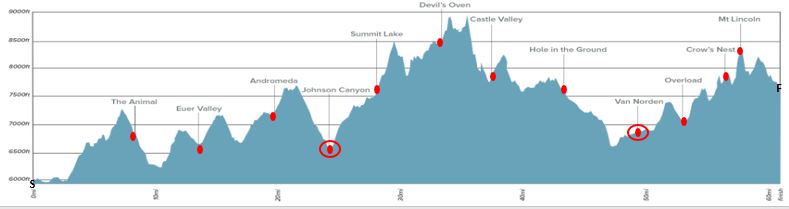
Elevation profile
Start to Johnson Canyon (Start to mile 25): Got separated from my buddies Greg and Rob soon after the start when I had to duck into the woods for a quick nature-poo. I hoped to join back up with them but I was patient and let them go, and ran mostly alone for 25 miles. This was a very enjoyable section…temps were low – borderline chilly – and it’s always nice to be running in the woods when it turns from dark to light. The trails north of Truckee are great running, and I made a deliberate effort to try to run light and efficient. I had a very loose estimate to expect to hit mile 25 at 4.5 hours, and somehow I nailed it right on. I felt exceptionally fresh coming into Johnson Canyon aid station.
Johnson Canyon to Castle Valley (25 – 37): The crux. This section starts with a five mile long, two-stage climb up out of Johnson Canyon. During this climb the heat of the day starts to hit you, as does the effects of sustained steep power hiking. But at mile 30 you are rewarded as you crest a gentle saddle and drop down into the valley north of Castle Peak. This valley is absolutely stunning, and in my opinion easily the most beautiful part of the course. I never stop to take pictures during races, but I kinda wish I had a few to show from this valley. There is one very specific part that stands out in my memory: the trail comes up the backside of a terrain feature and into a small stand of pines, then turns left around a tree….and in a matter of a single step, the entire massive north face of Castle Peak comes into unobstructed view. It is pretty dramatic. I had to stop for a second or two to soak this in. No, I didn’t cry. And sorry, no pic….you’ll have to go run it to see for yourself.
Views aside, the valley run is tough. It’s mostly exposed to the sun, sheltered from breeze, and hot. Lots of short steep climbs throughout. I had to be really careful going through here not to push too hard and put myself at too much of a deficit….I definitely got close a few times. The effects of the high altitude became quite noticeable. Even though it’s only a five mile section, I drank almost my entire 70oz bladder of water, and was becoming concerned that I would run out and start slipping towards dehydration. As it turns out, I made it into the Hell’s Kitchen aid station, a little light headed from the altitude, but well hydrated and ready to keep pushing.
The 2-3 miles out of Hell’s Kitchen are high-alpine ridge running. From the aid station is a short push up to Basin Peak, with 360 degree views of the whole North Donner pass wilderness area. From there it’s a wide open ridge due south to the race’s high point and namesake, Castle Peak, where the trail skirts the summit and then drops steep and technical down to Castle Valley.
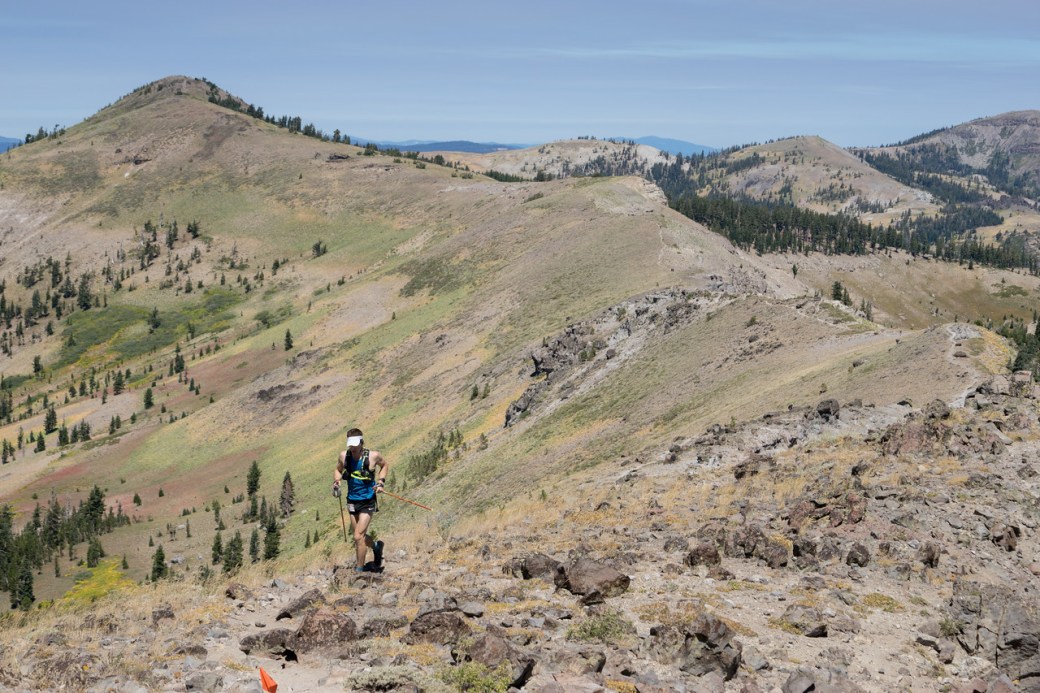
Unknown runner on the Basin to Castle Peak ridgeline. Basin Peak in the background. Photo by Bill Stevenson
My entire race strategy hinged on coming out of this crux section ready to make a hard push down to Van Norden. So when I got to Castle Valley aid station at mile 37 feeling energized and upbeat, I was all smiles. It’s truly one of the best feelings in ultra-running.
Castle Valley to Van Norden (37 – 50): This was where I was going to make my move….I left Castle Valley feeling great and ready to push. A short mile or two up and over a ridgeline, and the trail dropped down into the long 11-12 mile “Hole in the Ground” section. This is a popular mountain bike trail, with lots of purpose built berms and features for bikers. It’s long and lonely, and only broken up by a single aid station about halfway through. Rolling at first, it turns into a sustained downhill after the aid station. I felt like I ran this whole section really well, and moved up five positions in the field. I missed a turn towards the end of the section and gave back a few of those positions (more on that below), but I felt good coming off the mountain and approaching Van Norden aid station.
The final mile into Van Norden is on the road….a miserable mile. You really can feel how the pavement radiates heat. Plus, I’m a spoiled trail runner – any pavement and I start to get grumpy. But there’s no way for the race planners to avoid this…we have to cross over the I-80 and the only way to do that is on roads. I arrived into Van Norden, mile 50, at about 10 hrs 20 minutes.
Van Norden to Finish: (50 – 62): If you read my pre-race strategy, it was pretty focused on coming into Van Norden strong. My plan for miles 50-62 was limited to, quote: “hopefully [I’ll] have some juice left to press the last 12 miles of the race.” I should know by now that “hopefully” isn’t a good strategy.
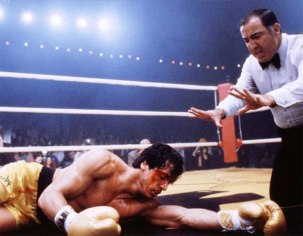
I felt fine leaving Van Norden, but about a mile and a half later the wheels started to come off. Low juice. Running intervals got shorter and hiking intervals got longer. Two runners that I had passed earlier re-passed me pretty decisively, as they were having late-race surges. Confidence was declining. And as a nice icing on the cake, I managed to get my poles tangled in my feet and took a brutal spill, face to dirt. It was only my visor that saved my face from serious trail-rash. As I laid there for a few seconds in the dirt and dust, this is what I felt like:
That’s ok though, because a few miles later I made it into Crow’s Nest aid station. Crow’s Nest is at mile 57 high on the ridgeline above Sugar Bowl, and is immediately before the infamous Palisades section. Last year the Crow’s Nest aid station pulled me out of a deep funk, and as I arrived there this year I told the crew there that I needed more of their good vibes. For the first time all day, I sat down. I snacked on a half PB&J and some watermelon, chatted with the aid station volunteers, and just chilled out for a few minutes. 5.4 miles to go. If I could cover this ground in under 1 hour and 40 minutes, I’d break 14 hours. I got up, thanked the volunteers for saving my ass two years in a row, and headed into the Palisades.

A portion of the Palisades, just past Crow’s Nest. Photo by Kane Cullimore, from 2017
The Palisades are notorious – a 1.25 mile long, technically demanding, steep and jagged uphill section very late in the race. However, in my opinion there’s a silver lining – they are a natural forcing mechanism (or excuse, depending on how you look at it) to slow down. Terrain is the limiting factor here, not fitness. Its scrambly and moderately exposed, requiring you to use your hands to negotiate rock-climby sections, but there are course safety observers and a few fixed ropes in the dicier sections. This section also compresses the field, because of the difficulty and a few bottlenecks. The Palisades top out on top of Mount Lincoln, and from there it is four miles, mostly downhill, to the finish. Between Crow’s Nest and the Palisades, I’d managed to find my legs again, and was able to run strong to the finish line. I thoroughly enjoyed the last two miles down the mountain. As I approached the finish line, I saw the family and I asked Finley to walk me in.

Crossing the finish line with Finley. Photo by Helen Pelster
Finley and I crossed the finish line at 6:42pm. Some of my tahoe buddies were there too: Jackson, Mike, Adam, and Annie, and their kids. They were on point with much-needed beers for rehydration and recovery. A good way to finish a great day.
What I could have done better
I’ll hit these first, then on to general takeaways.
Aid station plans: This seems to be a common theme of mine at races. I do well at the non-crew, non-drop-bag aid staions, but not so well when variables are added to the equation. I had put more effort than usual into drop bag logistics for Castle Peak, and had a good mental checklist going into the mile 25 Johnson Canyon aid station, but still managed to screw it up. Long story short…I got distracted in the aid station by some issues with my bladder’s sealing mechanism, and I left out of there without grabbing my extra water bottle. This extra water was to be a reserve supply going through the difficult crux section (the next two aid stations had limited supply of water, due to their remoteness). Luckily I ended up not needing it, but if I had, it would have been a costly error.
Van Norden aid station went a little better, but I even screwed up there. See next point:
Don’t be a D to your race-crew: As I was leaving Van Norden aid station (mile 50), I had a moment. I thought about my future finish line beer (as I often do throughout races), and how good it would be if it was nice and cold. I turned around and yelled across the aid station parking lot to my wife, in a serious voice and in full earshot of most of the spectators: “Hey!…make sure my Sierra Nevada is cold at the finish line!” Then I turned and ran off as she gave me the WTF stare. A minute or two later as I was down the trail a bit, I realized that that probably wasn’t a super slick way to make that request. I’d been focused on getting out of the aid-station, and my brain-mouth-filter malfunctioned. Lesson: even if you’re tired or goal-focused, don’t forget to not be a D.
Missed turn: At mile 48.5 I missed a left turn off a fireroad onto singletrack. This tends to happen on fireroads, where the technical and mental ease of running makes it easy to zone out and miss things. Last year I missed a different turn at Castle Peak – also a left turn off fireroad onto singletrack. Jim Walmsley’s famous missed turn while leading the 2016 Western States run was a left turn off a fireroad onto singletrack. Watch out for those left turns off fireroads!
This turn was super-well marked with orange ribbons, and there was even a decent size log laid across the road to serve as a physical barrier to steer you into the turn. However, I was undeterred by these indicators… I jumped the log and continued my determined run straight down the fireroad. Luckily for me, the road dead-ended into private property about a quarter mile later, and I snapped out of it and backtracked up the fireroad to the missed turn. All in all it probably cost me about five minutes. Given how the race turned out, I’m not worried at all about those minutes. If I’d have finished in 14:01 though, I’d be really beating myself up about this mistake.
Late race fade: I don’t like fading like that at the end of a race. I don’t suppose many runners do. I’d much rather run a race where I am able to press the effort through the last 10-15 miles, rather than just holding on and trying not to shit the bed. It is inevitable in ultra-running that you will have bad sections in races. I’d just prefer mine not be right at the end.
This late-race fade was largely a product of my gameplan. It really only addressed the first 50 miles of the course, and didn’t give these last 12 miles the respect or attention they deserve. As a result, this section kicked me in the groin and made me apologize for my lack of respect. I’m sorry, final section.
Reflections and Random Thoughts
Falls: I took a few good dingers. By my memory there were at least four that fully laid me out. Two of them were really gnarly…..poles went flying and everything. The first one I pitched head first into a rock garden, and it was just through sheer luck that I didn’t smash a critical body part or joint into a sharp rock. The second one was the aforementioned self-induced pole-trip to face.
Race eats: I think I’ve found my menu of choice in ultras. PB&J (preferably cut into quarters), watermelon cubes, with a side of pretzels. Garnish with occasional salt tabs on the go, and you’ve got a complete race meal! I took a couple gels during the race, but I don’t really like them. They work, but they leave a lingering sticky aftertaste, create trail-trash (most of the trash I see on trail is some form of gel-packet), and no matter what you do it gets on your fingers.
Poles: A gamechanger. Not only do they take some strain off your legs and make you more efficient on the uphills, but they’ll also help keep your ego in check by tripping you to the ground onto your face. I unstowed them about two miles into the race, and kept them out the entire rest of the day. A must-have for big-mountain courses.
Bladder system: It is good because: 1) it carries a lot of water, and 2) it is out of the way on your back. It is bad because: 1) you have to take the vest off at aid stations to refill, 2) the sealing mechanism can get jammed up, as it did at Johnson Canyon, and 3) maybe it’s just mine, but I have to exert a significant amount of diaphragm “sucking” effort to get water out of it. And while I’m sucking water, I’m not breathing. Often after a few hard fought sips, I’d find myself gasping for air. Air or water….what’s more important? Kind of a ridiculous decision to have to make during a race.
Hydration: I drank hard. Despite the quirks with the bladder’s delivery system, I was pounding water throughout the day. I knew that if I got behind on hydration, it would be easy to slip into a downward spiral that magnified the effects of fatigue, heat, and elevation. And aside from that, I was always thirsty. It seemed I just couldn’t drink water fast enough. Often during the day I’d have to ignore thirst and hold off on drinking because I was getting sloshy. In the high-and-dry environment of Donner Pass, my body was like a insatiable sponge.
Elevation: 13:42 was a faster time than I expected to run. But I’m hard headed….I always think I can do better. Especially if I was 100% healthy and had a full unconstrained 3-6 month training block leading into the race. But assuming I continue to live and train at sea level, I do believe that my performance ceiling on this course is somewhere in the low 13’s. I could absolutely go faster than that, but to do so I’d have to live and train at altitude. Maybe someday.
Coming from sea level to run a 100k at above 7000 feet is no joke. The effects are most noticeable and acute at high-intensity efforts, but physiologically they are always there. There’s lots of hard science behind it (good irunfar article on it here), and there are things you can do to mitigate the effects, but bottom line is that your body needs time to adapt to the reduced O2 content.
Hip: What hip? In all seriousness, I still can’t explain or understand how it did as well as it did. Much like Sonoma, I felt it a bit in the first few miles, then it was a non-factor for the rest of the race. I don’t even remember really thinking about it. I kind of tweaked it once when I fell, but as soon as I got up and moving again it chilled out.
The hip is a game-day performer. It doesn’t like showing up to practice some days, but it performs when it counts.
Related note: my right quad was the only thing that gave me a little bit of grief. It got pretty tight during the race and a little painful. Not to the point where it affected anything, but I noticed it. I have been neglecting my right side in favor of the injured left, and I have noticed that my right quad and hip are now tighter than their left side counterparts. Time to start giving the right hip some love too.
Finisher’s belt: I love that this race gives a belt to all the finishers. It’s leather and has the Castle Peak logo on the back. Here’s the catch though….there’s no buckle. Gotta go out and earn a buckle in a 100 miler. In 2017 I got a buckle for my Castle Peak belt three weeks later in Arizona. Now I have another belt in need of a buckle. Heading to Utah in six weeks to try to get one.
Thank yous: A few quick shout outs:
- Race Directors Helen, Peter, and Sean, and everyone else at Donner Party Mountain Runners who helps put this event on.
- All the volunteers who make it possible
- The Crow’s Nest crew
- My coach Corrine, for designing my training program and for believing in me through some difficult training periods.
- My race and life crew: Allie and Finley
Wrap up
After I was done, we hung out at the finish for a while and watched Greg and Rob finish. My wife Allie was a champion again… an expert at multi-tasking as crew leader and mom (and beer-chiller).
Some folks finish races, and then take off soon thereafter to go find a place to lay down. Instead, I enjoy hanging out in the uplifting finish-line atmosphere and watching the runners come in. Just by being there, you get to share in the experience of these runners achieving something they’ve been working many months for. They’re exhausted, but have huge contagious smiles.
Castle Peak reminded me why I love this strange but simple sport. After a long and somewhat rocky four months since Lake Sonoma, Castle Peak reaffirmed my relationship with ultra-running. There’s too much to go into here, but everything’s integral: the community, the trail environment, race-strategies, self-doubt, hitting goals, falling short of goals, feeling invincible, feeling like garbage, bouncing back, and walking with your 2 year old the final 50 yards of a 62 mile day.
//
This is a recovery week for me, but I’ll be back into training by this weekend, in prep for the Bear 100 miler, the last weekend in September. I’m going up there with Greg, and we’ll both be running it. Now that Castle Peak is done, the Bear moves to the forefront of my mind. 100 miles is a whole nother animal.
 bradswebblog.com
Awesome recap Brad!
I had to laugh about being a D to your support crew. The only time I have ever cursed at my mother was at mile 43 of the JFK. I will have to tell you the story sometime. I still apologize to her for that everytime i see her.
LikeLike
Great recap of this race…..I almost felt like I was there with you! Especially liked the take away, “don’t be a D”…..it’s super important that your support team be appreciated. I know you know that, but when you are bone tired, it can be forgotten! Glad your hip has cooperated!
LikeLike
That last comment was written by me, your Mom (not dad!)
LikeLike