Race info at a glance:
Location: Lake Sonoma, CA (90 min N of San Francisco)
Date: 14 April 2018, start time 6:30am
Distance: 50 miles
Surface: 86% singletrack, 9% doubletrack road, 5% pavement
Vertical gain: Officially 10500 feet. My garmin recorded 9,928
Wx: Cool for first 3 hours, then hot
Starters: 338
Finishers: 292
Result
Time: 7:45:45
Place: 23rd Overall, 21st Male
//
Up front, I will say two things:
1) I ran about as well as I could have on this day.
2) I didn’t accomplish my goal of 7 hrs 30 minutes.
The first point is more important than the second. The 7:30 goal will roll forward to another day.
However, I had a plan for 7:30 (see Pre-race post), and the fact that I didn’t run 7:30 means that things didn’t go according to plan. This blog post will consist of a short recap of the race, and then an autopsy of the plan; why and how did 7:30 not happen. If this seems like I’m focusing on the negative, I’m not. Overall it went very well and I’m pleased with my run, the event, the field, and the whole experience. But, I will still use the 7:30 plan as the standard against which to critique my performance.
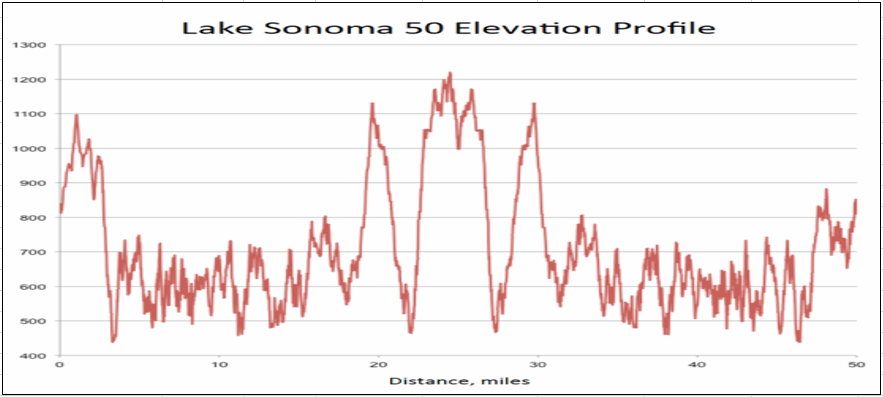
The Lake Sonoma course is really good. It lives up to its reputation: it’s relentless. Only a few significant sustained climbs, but tons of smaller ones. Almost zero flat miles…it’s all up or down. To run fast, the course demands a good mix of power, resiliency, and speed.
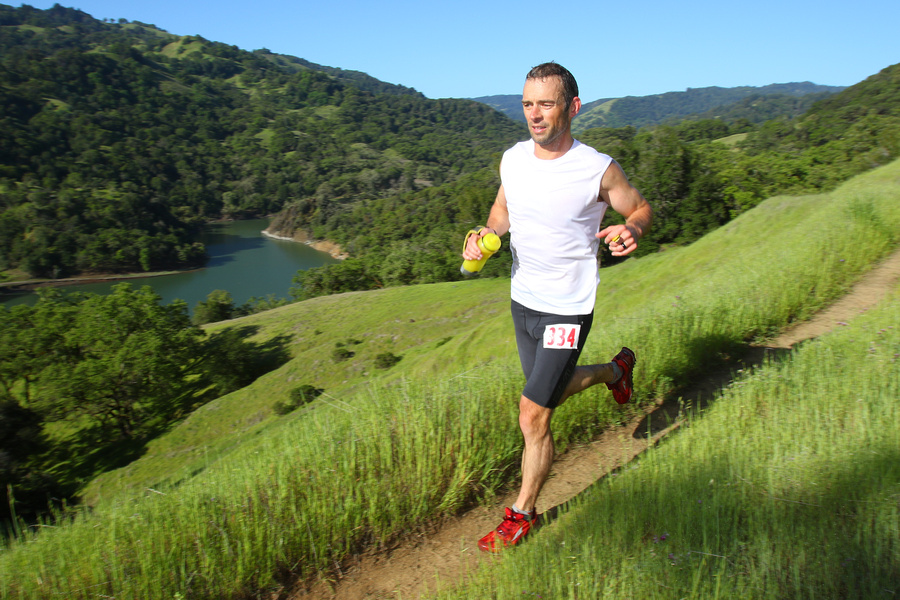
~mile 16
Short Recap….a few comments by section:
Miles 0 – 12: Shaded singletrack, cool temps, very rolling terrain, the field still pretty bunched up but spreading out by mile 12. Moved comfortably in groups of other runners through this section, focused on being efficient and managing effort.
Miles 12-25: Mostly exposed to the sun, stunning views. Slowly moved up through the more-spread-out field. Still steady-moderate pace, but perceived effort was increasing. Two of the race’s three significant climbs are in this section. Walmsley passed me on his return leg when I was at mile 21….8 miles ahead of me and a significant lead on 2nd place (he’d go on to break his own course record by 10 minutes and run a 5:51. Insane).
25-38: After the turnaround, mile 26 was mile-long steep downhill fireroad, which exposed a hole in my game. Quads took heavies on this descent. It was steep enough that I had to ride the brakes the whole time, and when I got to the bottom, my legs were definitely effected. Work capacity was reduced for a few miles while the legs recovered from this (surprisingly, I actually made up time in this section). By mile 30 legs were feeling good again but heat and fatigue setting in through mile 38. Losing power on the climbs. Day was getting quite hot.
38 – 50: Back into the shaded forest. This section can be pretty lonely, but I caught up to a couple of other runners (turns out it was Hal Koerner and Paul Terranova…both accomplished ultrarunners), and kind of leap frogged with them for 7 miles into the last aid station. Felt strong on flats and downhills, kinda weak on uphills. Quick turn at the last aid station – I left just in front of Hal and Paul, and didn’t see them again after that. 7:45 was within reach. Passed two more runners in this section.
Finish: In the last quarter mile I recognized I would just miss 7:45. I was pretty anaerobic at this point, having pushed hard the final mile. When I came into the finish chute, I had no reason to sprint it in, so I grabbed Finley and carried her the last 100 yards across the finish. I was beat.
Then the ultimate reward: I sat down, took my shoes off, and cracked a fresh Montucky Cold Snack. 
Plan execution
First half: 3:39 (+6 from plan). Second half: 4:02 (+12 from plan)
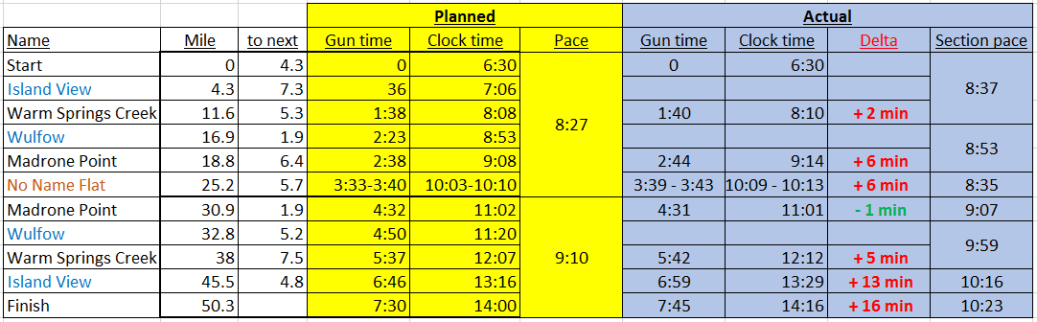
Below I’ve put my actual splits alongside my planned splits. I was actually surprised when I input this data into the spreadsheet and looked at the two side by side. I had really thought that I’d fallen behind my splits rather steadily across the 50 miles…that there wasn’t a specific section where I’d fallen off pace. But the data says otherwise.
As you can see from the splits chart, I fell slightly behind early, but then remained relatively close to the splits through 38 miles. Unbeknownst to me at the time, I was even a minute ahead of pace at the 31 mile mark. And I was doing well with the non-running aspects of the plan: staying hydrated, maintaining a slow but steady intake of calories and electrolytes, moving quickly through aid stations, and using the creek crossings to cool off.
Then, in the last 18 miles of the race, I lost 17 minutes on my splits, an average of 1 min per mile. I didn’t recognize it while it was happening though; there was no perceived significant slow down. Although I was losing some uphill power, I thought I was moving relatively well, especially on flats and downhill, and I was still moving up relative to other runners.
But the numbers don’t lie: I was slowing down. This is an area for improvement. I need to sustain pace better in the last miles of a race.
Here’s the profile again, for reference:
A significant note: I had committed my splits to memory ahead of time, mostly on the forty minute drive to the race Saturday morning. This is not a good method. When fatigue sets in, memory deteriorates, and this proved true when I couldn’t remember my splits in the second half of the race. I incorrectly thought I was further behind pace than I really was.
I wonder now that if I had known I was ahead of pace at 31, or only five minutes off split at 38, whether it would have given me a little psychological boost. Perhaps, but probably only a little bit, I don’t think it would have pushed me 16 minutes faster.
Regardless, losing track of my splits and not knowing where I am relative to my plan is not acceptable, and easily fixable.
So my paces fell off a bit late in the race. I definitely lost some uphill leg power, which matters a lot in the last 18 miles of this course, because there are several uphill sections per mile. How to fix it? I don’t know, but perhaps I need to work more vert into the later miles of my long runs, to condition the legs to climbing/descending while tired. Or more hill sprints.
Overall though, there is still a positive spin to this. Of all the reasons to fall short of a time goal, the simple “couldn’t run fast enough” reason is probably the best one you can hope for. My training in the months leading up to the race was good…I don’t think I fell short due to any shortfall in my training regimen.
It would be more disappointing to miss a goal due to dehydration, bad blisters, a bonk, getting off course, etc etc. I had none of these issues….I just wasn’t fast enough. This is ok. I can get faster.
What could I have done different?
If I was transported back to last Saturday morning, what would I (or could I) do different? Well not much….I stand by my original point that all things considered, I ran it about as good as I could, just not fast enough. But given the luxury of hindsight, there are a few minor things that maybe would have helped. Debatable whether or how much they would have reduced my overall time, but worth noting. These are:
1) Splits: I should write them on my arm with a sharpie, or tape em to a water bottle, or figure out a way to program them into my watch, or put them on a giant banner and hire one of those airplanes to tow it through the sky above the course. Anything besides memorization.
You can’t plan on being able to remember a bunch or numbers late in a race. I know this, I knew this….but I still did it.
2) I ran miles 14-19 steady but maybe a little too conservatively. I settled in behind another runner and let him pull me along for a few miles while we talked a bit. We were moving well, but comfortably. This is perhaps the prettiest section of the course, high above the lake with great scenery. I knew the big climbs were coming up at mile 20, and there were still many miles to go after that, so I think I held back a bit. In hindsight I may have given up a few minutes in this section….perhaps I could have pushed a little harder without compromising my legs, and caught back up to or even gotten ahead of my planned splits.
3) I had planned for five minutes at the turnaround. I spent four. I could have spent one. Didn’t prep some of my gear correctly to expedite the turnaround. The break was more psychological than physical.
4) The last 4.5 miles were easier terrain than I expected, so even though I ran them hard, I was in a “don’t blow up now” mindset, rather than a “push these last miles” mindset. At the pre-race dinner the evening before, a guy told me that this final section was harder than it looks. This beta, while well intended, probably threw me off a little. It was net uphill, true, but not that bad, and actually fairly mellow. What made it hard was not the terrain, but rather the fact that it was the last 4 miles of a 50 mile race. Possibly could have gained a minute or two through here.
Key takeaways
The good:
– Relative position: Moved up through the day, never lost position. The few times I did get passed, I ended up repassing.
– Consistency: Well… relative consistency I guess. I slowed down at the end, but so did almost everyone else in the race. I didn’t have any real low points, bad miles, or spots where I had to pull it together. Work capacity stayed high throughout.
– In-race hip: Felt it a little in the first 6 miles or so, then not at all for the remainder of the race.
-Fun: I had fun for the entire 7 hours and 45 minutes. Some of it type II, but fun nonetheless.
The “not as good”:
– Split awareness: already hit on this. Kinda lost situational awareness and maybe let go of 7:30 a little early.
– Downhill quads: Smoked em at mile 26, they didn’t feel good for a few miles after that.
– Late race uphills: running power kinda fell off more than I’d like. Hiking power stayed good (thank you incline treadmill), but I was power hiking some hills that I think I should have been able to run.
– Pace in last 12 miles: Too slow.
– Post-race hip: I’m writing this Thursday after the race, so it’s been five days. Monday the hip was bad….as bad as it’s ever been. The few days since have been better, and I ran a comfortable four miles on it today, but I am still uneasy and concerned about it. I’ll probably extend my rest a little bit to see where it settles out, and go from there.
Wrap up
So, these are all good lessons. Good things to work on and improve for next time. One of the things I like about ultrarunning is that, being still relatively new to it, I still learn a ton from every race.
There are no perfect races, but there are good races. This was a good race.
The big question for me right now is the hip. How will it hold up through the rest of the spring and summer? How much pain should I continue to run through? I’m working through these issues right now with my physical therapist….will keep the blog updated.
Next race is Broken Arrow 52k in June.
 bradswebblog.com
Pingback: Running vs Biking |